
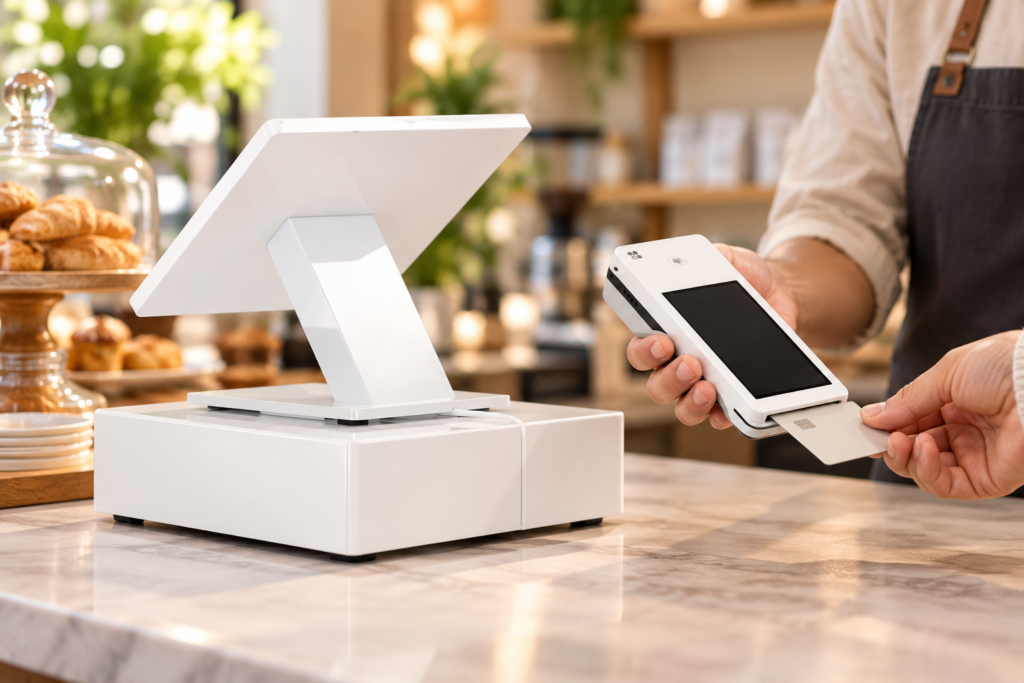

How Clover POS works is straightforward: the system combines point-of-sale software, compatible payment hardware, and an approved payment-processing service to help businesses accept payments, record sales, and manage everyday operations. Depending on the Clover device and software plan, a business can also track inventory, manage employees, review sales reports, and use compatible third-party applications.
For small businesses, Clover offers more than a way to accept credit and debit cards. It can serve as a central system for checkout and related business activities.
However, choosing Clover involves several important decisions. The hardware, software subscription, payment-processing relationship, available integrations, and ongoing fees all affect how well the system fits your business.
I’ve worked with merchants since we founded Valued Merchant Services in 2006. One thing I’ve learned is that two businesses can purchase similar-looking POS equipment and have very different experiences because of their software needs, processing agreements, and daily workflows.
A coffee shop may need quick order entry and tipping. A retail store may need barcode scanning and inventory tracking. A full-service restaurant may need tableside ordering and kitchen communication.
That’s why understanding how Clover POS works is more useful than choosing a device solely because it looks impressive in a demonstration.
How Clover POS Works: Quick Overview
Clover POS at a Glance
- Payments: Accept eligible credit cards, debit cards, chip transactions, contactless cards, and supported digital wallets.
- Hardware: Choose among compact countertop systems, handheld devices, and larger POS stations.
- Software: Manage sales and access additional business features according to the selected subscription.
- Reporting: Review transaction activity and applicable business reports through Clover’s dashboard.
- Apps: Add compatible third-party tools through the Clover App Market, often with separate charges.
- Processing: Requires an eligible Clover-supported payment-processing arrangement.
- Costs: May include hardware, software subscriptions, transaction fees, and optional applications.
- Important limitation: Clover hardware is not universally compatible with unrelated merchant processors.
What Is the Clover POS System?
Clover is a point-of-sale platform that combines payment acceptance with software designed to support business operations.
The platform includes dedicated payment devices, a cloud-based dashboard, software plans, and an application marketplace.
Depending on the configuration, Clover can help a business:
- Accept eligible in-person card payments
- Calculate and record sales
- Send or print receipts
- Track products and inventory
- Apply taxes, discounts, and applicable tips
- Manage employee access
- Review sales and transaction reports
- Maintain customer information
- Offer supported gift card and loyalty programs
- Use compatible business applications
Not every feature is included with every Clover plan or device. Certain capabilities require additional software, accessories, provider support, or third-party subscriptions.
That distinction matters when comparing Clover with other POS systems.
Our complete POS buyer’s guide explains how to compare different point-of-sale platforms. This article focuses specifically on Clover and its payment-processing ecosystem.
How Does Clover POS Process Credit Card Payments?
The checkout process generally begins when an employee creates a sale using an eligible Clover device or connected application.
Let’s use an example of a customer purchasing $32 worth of merchandise at a small retail store.
Step 1: Enter the Products or Sale Amount
The employee selects products from the configured Clover catalog or enters a permitted sale amount.
Depending on the setup, Clover can apply the appropriate taxes, discounts, and other transaction adjustments.
The employee then moves to payment.
Step 2: The Customer Presents a Payment Method
The customer taps a supported contactless card or mobile wallet, inserts a chip card, or uses another payment method supported by the device and processing arrangement.
Modern Clover devices can support payment options such as eligible Visa, Mastercard, American Express, and Discover cards, along with Apple Pay and Google Pay.
Some configurations support additional payment types, including gift cards, cash, or eligible specialized programs. These capabilities must be confirmed for the particular merchant account.
Step 3: Clover Requests Authorization
The payment system securely communicates the appropriate transaction information through its configured processing infrastructure.
The card issuer evaluates the payment request and returns an authorization response.
An approval typically allows the transaction to proceed, subject to the payment method and applicable transaction rules.
However, an approved authorization is not the same as a completed merchant bank deposit.
Step 4: Clover Records the Transaction
After a successful transaction, the POS records the relevant sale information.
Depending on the configuration, it can update the transaction history, associated order records, and appropriate inventory information.
The customer may receive a printed receipt or an electronic receipt through supported features.
Step 5: Settlement and Merchant Funding Follow
Captured transactions enter the applicable clearing and settlement process.
The merchant then receives eligible proceeds according to the payment-processing and funding agreement.
The exact deposit schedule depends on the provider, transaction activity, account eligibility, processing cutoffs, and other applicable conditions.
Important: A Clover device accepting a transaction does not mean the merchant has received the funds. Authorization, capture, settlement, and funding remain separate parts of the payment process.
Clover POS Hardware: Flex, Mini, Station and More
Clover offers several hardware options designed for different checkout environments.
The right device depends on available space, employee workflow, customer interaction, and the business software features you need.
Clover Flex: Portable and Tableside Payments
Clover Flex is a handheld POS device that supports eligible chip, contactless, and other card transactions.
Current models feature a touchscreen and built-in receipt printer, along with supported wireless connectivity.
Depending on the software plan, Flex can support product selection, business reporting, and other available POS functions.
It may be useful for:
- Restaurants collecting payments tableside
- Retailers offering assisted or mobile checkout
- Food trucks and market vendors
- Service businesses accepting payments away from a fixed counter
Clover also offers Flex Pocket, a lighter handheld option that uses digital-only receipts rather than the built-in receipt printer found on Flex.
The distinction matters if your business needs to provide paper receipts on the spot.
For current device details, see Clover’s official Flex information.
Clover Mini: Compact Countertop POS
Clover Mini is an all-in-one countertop system designed for businesses that need payment acceptance and supported POS functions without a large register setup.
Current Mini models provide a touchscreen, integrated card acceptance, and receipt capabilities.
Mini can be suitable for smaller retail counters, cafés, service desks, and other businesses with limited checkout space.
Depending on the subscription, businesses may also use available product management, reporting, and other applications.
Before ordering, verify which software plan and accessories are included.
See Clover Mini specifications for more information.
Clover Station Solo: Full Countertop System
Clover Station Solo is designed for businesses needing a larger primary POS interface.
It can support more involved checkout processes, reporting, and compatible peripherals through the selected configuration.
Businesses with extensive product catalogs, multiple employees, or more demanding checkout procedures may prefer a full station over a compact terminal.
However, a larger system isn’t automatically better. The business must actually benefit from its features and additional hardware.
Clover Station Duo: Customer-Facing Checkout
Clover Station Duo combines a merchant-facing screen with a separate customer-facing display.
Customers can review eligible order details, interact with payment and tipping prompts, and select supported receipt options.
This configuration can help certain stores, cafés, and counter-service restaurants keep the transaction process organized.
Current Station Duo models include a 14-inch merchant display and an 8-inch customer display, according to Clover’s product documentation.
See the official Station Duo specifications.
Other Clover Devices and Accessories
Clover’s lineup also includes devices such as Compact, Go, and additional options for supported business needs.
Some businesses use approved scanners, cash drawers, printers, kitchen displays, and other peripherals.
Always verify compatibility with the exact device generation, software plan, and processing arrangement.
Clover Hardware Comparison
| Device | Typical Application | Important Difference |
|---|---|---|
| Flex | Tableside and portable checkout | Handheld device with built-in receipt printer |
| Flex Pocket | Compact handheld checkout | Digital receipts rather than a built-in printer |
| Mini | Small countertop checkout | Compact all-in-one POS with touchscreen |
| Station Solo | Primary retail or restaurant register | Larger merchant-facing POS interface |
| Station Duo | Counter service with customer interaction | Separate merchant and customer displays |
These are practical comparisons, not guarantees that every advertised feature is included in every device package. Actual capabilities and pricing depend on the selected model, subscription, and provider.
What Can Clover POS Software Do?
Clover’s software provides the business functions that operate alongside the payment hardware.
However, software capabilities differ by merchant service plan, business category, and supported application.
Sales Reporting and Transaction Management
Businesses can use Clover’s reporting tools to review eligible sales and transaction activity.
Depending on the subscription, reports may help owners examine sales by period, employee, product, or other available categories.
These tools can make it easier to understand activity without manually adding up individual receipts.
However, merchants still need to reconcile sales, refunds, adjustments, processing charges, and deposits accurately.
Product Catalogs and Inventory
Supported Clover plans allow businesses to create items, categories, variants, or modifiers.
For example, a clothing retailer may need products organized by size and color.
A café may need drink sizes, extras, and menu modifiers.
More advanced inventory requirements may involve higher-tier software or compatible third-party applications.
Before buying, ask the provider to demonstrate your actual inventory workflow rather than assuming a feature is included.
Employee Access and Reporting
Depending on the subscription, Clover can help businesses manage staff profiles, permissions, and available reporting.
For example, a store manager may need more access than a cashier who only processes routine sales.
Setting appropriate permissions can help businesses maintain accountability and reduce unnecessary access to administrative functions.
Customer Management, Loyalty, and Gift Cards
Some Clover configurations offer customer engagement, rewards, or gift card functions.
These can be useful for businesses that encourage repeat purchases.
However, feature eligibility, fees, and the handling of customer information depend on the selected program.
Make sure the business actually needs the feature before adding another subscription.
Restaurant and Service Features
Certain Clover plans support restaurant functions such as order modifiers, tipping, tableside service, and compatible kitchen workflows.
Other software packages address appointment-based or professional service businesses.
There isn’t one universal Clover software configuration for all industries.
The selected plan should match the daily workflow.
Does Clover Integrate With QuickBooks and Other Apps?
Clover offers a marketplace of applications that can extend its functionality.
Some applications address inventory, accounting, customer loyalty, employee management, ecommerce, or other business needs.
However, being listed in the Clover App Market does not mean every integration is free or included in a basic software plan.
QuickBooks Accounting Integration
Businesses may be able to connect Clover transaction data with QuickBooks through compatible third-party applications.
For example, Commerce Sync offers an application in the Clover App Market that can transfer supported sales information to QuickBooks Online or other eligible accounting systems.
According to its published listing, Commerce Sync can help automate certain daily sales transfers and account for applicable sales information.
However, the integration requires a compatible application and has its own subscription terms.
It is not accurate to assume that every Clover account includes free automatic QuickBooks synchronization.
See the Commerce Sync App Market listing for current information.
Other Business Integrations
Additional applications may support specific operational needs, including loyalty programs, scheduling, reporting, and inventory management.
Before purchasing an app, verify:
- Compatibility with the exact Clover device
- Compatibility with the selected software plan
- Supported versions of your existing software
- Monthly or transaction-based app charges
- Whether data synchronization is automatic or manual
- How refunds, discounts, taxes, and adjustments are handled
- Who provides technical support
- What happens if you cancel the app
These questions matter because an integration that works well for one merchant may not support another merchant’s software version or reporting requirements.
How Much Does Clover POS Cost?
Clover POS costs depend on the hardware, software plan, payment-processing agreement, and any additional services the business selects.
There is no single total Clover price that applies to every merchant.
For a meaningful comparison, separate the expenses into four categories.
1. Clover Hardware Costs
Some merchants purchase Clover devices upfront. Others may have access to eligible hardware subscription or financing arrangements.
Hardware subscriptions and purchase agreements can have different terms, including warranties, commitments, return obligations, and upgrade conditions.
A low initial payment does not necessarily mean the device is free over the life of the agreement.
2. Clover Software Subscriptions
Clover offers different software packages for different business types and feature requirements.
For example, a business needing basic payment acceptance may not require the same plan as a restaurant managing orders, menus, and tables.
Some configurations include additional monthly charges for devices, locations, or specialized features.
Ask for the current software plan and complete subscription terms in writing.
3. Payment Processing Fees
Card processing fees may include a percentage of the transaction amount, a fixed per-transaction charge, and other applicable account fees.
Rates can differ by processing arrangement, transaction method, and business characteristics.
For example, manually entered or other card-not-present transactions may be priced differently from eligible in-person payments.
The amount displayed on Clover’s direct website is not necessarily the same pricing available through every authorized Clover partner.
4. Third-Party Applications and Accessories
Accounting integrations, specialized inventory tools, loyalty applications, printers, scanners, and other services may create additional expenses.
These charges can be especially important for merchants using several connected business applications.
A Practical Clover POS Cost Example
Consider a retail business processing $12,000 per month through 300 card transactions.
The following comparison illustrates why the complete proposal matters more than one advertised rate.
Hypothetical Monthly Cost Comparison
Arrangement A
Processing: 2.6% plus $0.10 per transaction
$12,000 × 2.6% = $312
300 × $0.10 = $30
Transaction fees: $342
Assumed software fee: $0
Illustrative monthly total: $342
Arrangement B
Processing: 2.4% plus $0.15 per transaction
$12,000 × 2.4% = $288
300 × $0.15 = $45
Transaction fees: $333
Assumed software fee: $25
Illustrative monthly total: $358
Difference: $16 per month
All rates and fees in this example are hypothetical. They are not actual Clover or VMS quotes, published averages, or guaranteed savings. Equipment costs, other fees, taxes, and additional subscriptions are excluded.
Although Arrangement B advertises a lower processing percentage, the assumed software expense makes its illustrative monthly total higher.
The real comparison should also include equipment costs, contract commitments, and business benefits.
Compare the Three-Year Cost
For larger POS installations, I also recommend evaluating the total cost over 36 months.
Include hardware purchases or subscriptions, software, additional applications, processing fees, accessories, maintenance, and possible cancellation obligations.
Official Clover pricing information explains its current direct-sales plans and relevant subscription arrangements.
Always request a proposal specific to your business and processing relationship.
Can You Use Clover With Any Credit Card Processor?
No. Clover hardware is not universally compatible with unrelated payment processors.
Clover’s payment environment is designed around supported processing relationships.
Although different approved providers may sell Clover equipment, that does not mean a merchant can freely reprogram the device for any processor.
Clover itself warns that its devices cannot simply be used with other payment processors.
For VMS merchants, Clover availability and configuration depend on the eligible Fiserv-connected processing arrangements and supported hardware.
Can You Keep Your Existing Clover Device When Switching Providers?
Do not assume that you can.
Compatibility depends on the device, original acquiring relationship, ownership status, provider restrictions, and available migration procedures.
A merchant who owns a Clover terminal may still face limitations when attempting to move it to a different processing arrangement.
Before signing with another provider, ask:
- Can the existing device be used with the proposed processor?
- Does the current equipment agreement permit the change?
- Will the merchant need to buy replacement hardware?
- What happens to POS settings and saved product information?
- Can transaction records and customer data be exported?
- Who handles the transition and testing?
These questions may prevent an expensive surprise after a processing contract is signed.
Can You Integrate Clover With Non-Clover Software?
Some supported integrations allow external business software to communicate with Clover devices or services.
However, integration does not necessarily mean independent payment processing.
For example, certain Clover APIs support connecting an outside POS application to compatible Clover payment hardware while the transaction still uses Clover’s supported processing infrastructure.
Ask for the exact integration documentation and confirmation of compatibility before proceeding.
Does Clover POS Work Without Internet Access?
Some eligible Clover configurations support offline payment acceptance when an internet connection is temporarily unavailable.
However, offline capability is not identical across every device, application, or integration.
More importantly, an offline transaction may not receive a normal real-time authorization response.
How Offline Clover Payments Work
When a supported Clover device operates in an approved offline mode, it may record eligible transactions for later submission.
Once connectivity returns, the system attempts to submit those payments through the applicable processing arrangement.
At the time of the offline sale, however, the system may not be able to confirm whether the card is valid or whether the issuer will approve the transaction.
Therefore, the merchant may be responsible for a payment that later fails.
Some Clover configurations allow merchants to set offline transaction limits or disable the functionality.
Other configurations, including certain Clover Go integrations, do not support offline payment acceptance.
Important: Offline acceptance is not guaranteed payment. Verify whether your actual Clover system supports offline transactions, what limits apply, how payments are uploaded, and who bears the risk if a transaction is later declined.
Clover explains these limitations in its offline payment documentation.
What About Payment Security and PCI Compliance?
Clover offers modern payment-security features, but using Clover does not automatically satisfy every PCI DSS responsibility for the merchant.
Businesses still need to manage device access, employee permissions, appropriate network security, sensitive information, and their applicable compliance requirements.
Employees should use supported payment applications and avoid retaining card information in unprotected notes, spreadsheets, or messaging systems.
Merchants should also verify current security and compliance obligations with their acquiring institution and payment provider.
Which Businesses Are a Good Fit for Clover POS?
Clover can work for a variety of small-business environments, but the right configuration depends on the operation.
Retail Stores
Retailers may benefit from product catalogs, barcode scanning, supported inventory features, sales reporting, and integrated card payments.
For example, a boutique may use Clover Mini or Station hardware to ring up clothing purchases and manage the appropriate inventory records.
However, a retailer with complex purchasing or warehouse requirements should confirm whether Clover’s available tools meet those needs or require additional applications.
Coffee Shops and Quick-Service Restaurants
Cafés often need fast checkout, menu modifiers, tipping, reliable receipts, and an organized employee workflow.
A suitable Clover configuration may combine a countertop POS with supported restaurant software.
The owner should test busy-period ordering, discounts, refunds, and end-of-day reporting before committing.
Full-Service Restaurants
Full-service restaurants may need handheld ordering, table management, kitchen communication, and check adjustments.
Clover Flex and certain restaurant-focused Clover plans can support applicable parts of that workflow.
However, advanced functionality may depend on the software package, third-party applications, and compatible accessories.
Ask for a demonstration that reflects real menu items, modifiers, split checks, and employee procedures.
Salons and Appointment-Based Businesses
Salons, spas, and other appointment businesses may value scheduling, customer history, employee permissions, and payment acceptance.
Some of these capabilities are available through eligible Clover plans or compatible applications.
Before selecting Clover, compare the specific appointment workflow with other industry-focused POS solutions.
Mobile and Service Businesses
Mobile merchants may use Clover Flex, Clover Go, or an eligible payment-link arrangement, depending on the approved services.
However, a contractor who primarily needs estimates, project tracking, job scheduling, and invoicing may benefit more from a field-service system.
In that situation, Clover may handle payment acceptance while another platform manages service operations, assuming the integration is supported.
Our mobile payment solutions guide compares portable payment options in greater detail.
How to Set Up Clover POS for Your Business
A successful Clover installation requires more than unpacking a device and turning it on.
The provider must approve the merchant’s payment arrangement, and the system must be configured to match the business’s actual operations.
Step 1: Identify Your Checkout Requirements
Start by listing your business’s needs.
Consider the number of registers, mobile devices, employees, locations, product categories, and integrations required.
For restaurants, include menus, modifiers, tipping, kitchen equipment, and order management.
Step 2: Select Appropriate Hardware
Compare Clover Flex, Mini, Station, and other supported equipment based on your workflow.
Do not assume that buying the most expensive device will improve your operation.
Also confirm which peripherals are included and which must be purchased separately.
Step 3: Review the Merchant Processing Arrangement
Verify that the proposed hardware is compatible with the selected provider.
Request a written explanation of processing rates, software subscriptions, equipment charges, funding schedules, and contract terms.
At VMS, many eligible standard applications receive an approval decision in approximately one to two business days when the required information is complete. Equipment delivery and configuration may take longer.
Step 4: Configure the POS Software
Set up the products, menus, categories, taxes, discounts, employee permissions, and other relevant features.
If applicable, confirm how inventory and accounting systems will receive transaction information.
Complexity varies by business and subscription.
Step 5: Test Payment Acceptance and Reports
Follow the provider’s approved testing procedures.
Test supported payment methods, receipts, refunds, employee access, and reporting.
Verify that sales and deposits can be reconciled and that employees understand how to respond to declines or equipment issues.
Step 6: Train Employees and Confirm Support
Before going live, make sure employees understand everyday transactions and common exceptions.
Clarify who supports the hardware, payment-processing account, Clover applications, and third-party software.
Also establish procedures for internet outages, refunds, and end-of-day reconciliation.
Questions to Ask Before Buying a Clover POS System
These are the questions I recommend taking into a Clover demonstration or provider discussion.
- Which Clover device is best for my business? Ask for a recommendation based on your actual checkout workflow.
- Which software features are included? Get the specific plan name and feature list.
- What will I pay over 36 months? Include hardware, software, processing, apps, and other commitments.
- Can I use my existing Clover equipment? Verify the processor and device restrictions.
- Does Clover support my accounting and inventory software? Request confirmation for the exact integration.
- How does the system handle outages? Ask whether eligible offline payments are supported and what risks apply.
- How do I access my sales and transaction data? Ask about exports, reports, and account transitions.
- Who provides ongoing support? Identify the provider responsible for each component.
- What happens if I cancel or change providers? Review hardware ownership, subscriptions, termination fees, and data migration.
- Can I see the system handle my actual transactions? Request a demonstration using realistic products, returns, discounts, and employee workflows.
How Valued Merchant Services Helps Businesses Evaluate Clover
At Valued Merchant Services, we help business owners evaluate Clover alongside other suitable payment and POS technologies.
Since 2006, our approach has been to understand the merchant’s actual needs before recommending new equipment.
For a retailer, that may mean reviewing product management, checkout speed, and inventory.
For a restaurant, it may mean evaluating kitchen workflows, staff access, tipping, and tableside payments.
For a service business, it may mean comparing a Clover device with more specialized invoicing or field-service solutions.
We can help eligible merchants review available Clover configurations, processing costs, supported integrations, and account requirements.
We also believe a POS recommendation should include the complete cost of ownership and the practical limitations of the system.
If your existing equipment and payment-processing arrangement already work well, we’ll tell you when keeping them makes more sense.
That’s part of our commitment to putting people before profits.
Is Clover the Right POS for Your Business?
Before purchasing a POS system, let Valued Merchant Services help you compare equipment, software subscriptions, processing fees, and compatibility. We’ll explain the options and help you evaluate whether Clover or another supported solution better fits your business.
You can also contact our team, call 800-531-8575, or email support@valuedmerchants.com.
No obligation to switch providers. Clover availability, compatibility, pricing, software features, processing approval, funding, and support depend on the selected provider and merchant agreement. No particular savings or business result is guaranteed.
Frequently Asked Questions About Clover POS
How does Clover POS work for small businesses?
Clover combines compatible payment hardware, POS software, and an approved processing arrangement. Businesses can accept eligible payments, record sales, and use available reporting or business-management features according to their selected subscription.
Does Clover POS require a monthly fee?
Many Clover arrangements include recurring software charges, and certain hardware subscriptions or third-party applications have additional fees. Pricing depends on the plan, equipment, provider, and contract. Ask for a written breakdown before purchasing.
Can Clover accept Apple Pay and contactless cards?
Yes. Supported Clover devices accept eligible contactless cards and digital wallets such as Apple Pay and Google Pay. Actual capabilities depend on the device and configured processing arrangement.
Does Clover work with QuickBooks?
Compatible third-party applications can connect certain Clover sales data with QuickBooks. The integration may involve a separate subscription and must be compatible with the merchant’s devices, Clover plan, and accounting software.
Can I use Clover with another credit card processor?
Clover hardware is tied to supported processing relationships and is not universally compatible with unrelated processors. Before changing providers, verify whether your specific device can be supported and whether replacement hardware is required.
Can Clover process payments when the internet goes down?
Some Clover devices and configurations support eligible offline payment acceptance. However, offline transactions can later be declined, and not every Clover device or integration supports the feature. Merchants should verify eligibility, limits, and financial risk.
Which is better, Clover Flex or Clover Mini?
Flex is generally more suitable for portable or tableside checkout. Mini is designed for a compact countertop setup. The better choice depends on your business, required software, receipt preferences, and how employees collect payments.
Can I use Clover for a restaurant?
Yes. Clover offers restaurant-focused software and hardware configurations, including eligible countertop and handheld options. Features such as kitchen communication, order management, tipping, and table service depend on the plan and integrations.
Is Clover POS right for every business?
No. Clover may be a strong fit for certain retail, restaurant, and service operations, but businesses with specialized software, advanced inventory, or unusual integration requirements should compare alternatives before committing.
Final Thoughts: Look Beyond the Clover Hardware
Understanding how Clover POS works means looking beyond the touchscreen or card reader.
The real value comes from the combination of hardware, software, payment acceptance, reporting, integrations, and ongoing support.
For some businesses, Clover provides a practical way to simplify checkout and related operations.
For others, the processing restrictions, subscription structure, or software requirements may make a different solution more appropriate.
My recommendation is to evaluate Clover based on the transactions your business completes every day.
Test the checkout. Review the full pricing agreement. Confirm software compatibility. Understand the contract terms. And make sure your employees can use the system when the business is busy.
Since founding Valued Merchant Services in 2006, I’ve believed payment technology should solve business problems rather than create new ones.
The best POS is not necessarily the one with the most features. It’s the one that helps your business operate reliably, serve customers well, and control its total costs.
Sources and Additional Reading
For current Clover hardware specifications, pricing terms, integrations, and payment features, review these official resources:
- Clover: Current POS Hardware and Devices
- Clover: Software, Hardware and Payment Pricing
- Clover: Merchant and Equipment FAQs
- Clover: App Market
- Clover: Offline Payment Requirements and Risks
- PCI Security Standards Council: Payment Security Resources
This article provides general educational information. Device specifications, software subscriptions, integrations, processing requirements, fees, security responsibilities, and merchant funding arrangements may change. Verify current product availability and contract terms with the appropriate Clover provider. Clover and related product names are trademarks of their respective owners.
