

Credit card surcharging and cash discounting are two approaches businesses may consider when trying to offset payment processing costs. Although the terms are sometimes used interchangeably, they are not the same. Each involves different pricing methods, customer disclosures, payment rules, and compliance considerations.
For a small business owner, credit card processing fees can represent a meaningful ongoing expense.
Every transaction may involve interchange-related costs, card-network assessments, processor charges, and other applicable fees. These expenses can be particularly noticeable in businesses with high transaction volumes or relatively small average purchases.
It’s understandable that merchants want to find ways to reduce those costs.
I’ve worked in merchant services since we founded Valued Merchant Services in 2006. Over the years, I’ve watched merchants explore different pricing arrangements, from traditional interchange-plus processing to cash discounts, credit card surcharging, and newer dual pricing programs.
One thing I’ve learned is that a program should never be evaluated solely by how much processing expense it appears to eliminate.
Business owners also need to understand what customers will see, whether the equipment works correctly, what the applicable rules require, and whether the arrangement makes financial sense.
Let’s examine the differences between surcharging and cash discounting, how the programs work, and what merchants should consider before making a change.
What Is the Difference Between Surcharging and Cash Discounting?
The central distinction is how the customer-facing price is established.
What Is Credit Card Surcharging?
Credit card surcharging involves adding an eligible additional charge to a transaction when a customer pays with a credit card.
For example, a business may have an advertised price of $100 and, where permitted, apply a properly disclosed 2.5% surcharge to an eligible credit card transaction.
That would result in a transaction amount of $102.50 before considering applicable taxes and other circumstances.
However, the merchant cannot simply choose any surcharge percentage it wants.
The amount must comply with the applicable card-network rules, the merchant’s cost of acceptance, state law, and other requirements.
Importantly, Visa and Mastercard prohibit surcharging their debit and prepaid cards.
That prohibition applies even when a debit card is processed without entering a PIN or the customer selects a credit option at checkout.
What Is Cash Discounting?
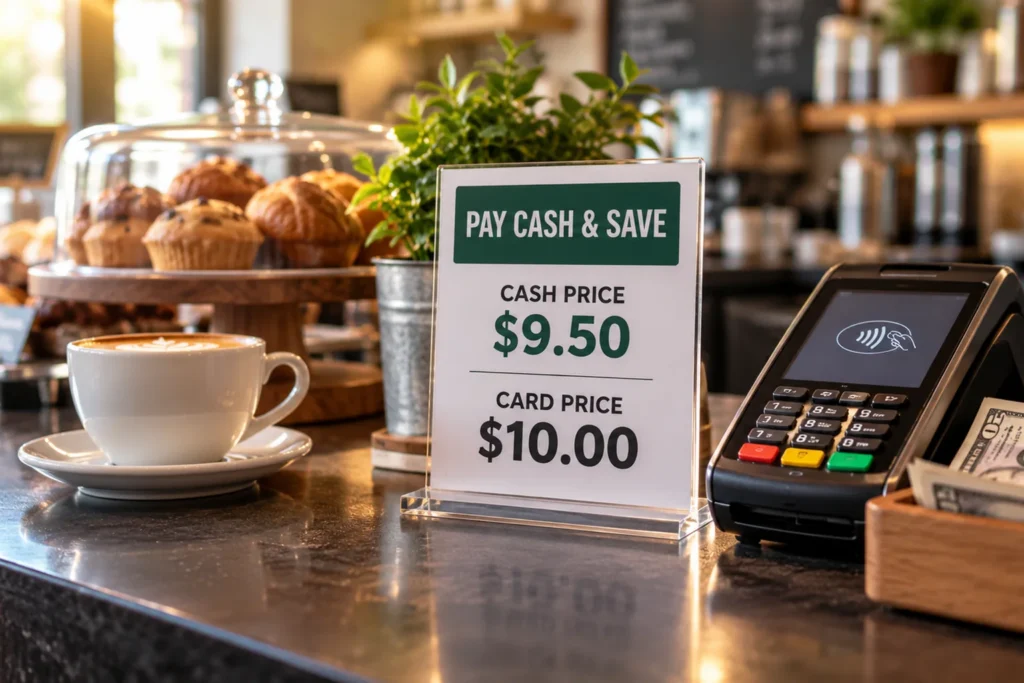
Cash discounting means offering customers a genuine reduction from the regular posted price when they pay with cash.
For example, a business may advertise a regular card price of $10.00 and offer a cash price of $9.50.
The customer receives a $0.50 reduction by paying cash, representing a 5% discount from the $10.00 regular price.
The difference is that the merchant isn’t adding a surprise fee to a previously advertised lower price.
Instead, the business clearly establishes its regular price and offers a discount for an eligible payment method.
Visa’s merchant surcharging guidance explains that proper cash discount arrangements should display either the regular card price or both the cash and card prices.
A genuine cash discount must not merely disguise an additional card fee under another name.
What Is Dual Pricing?
Dual pricing generally refers to presenting customers with clearly identified prices based on the payment method they choose.
For instance, a business may display both an eligible cash price and a regular card price for a product or service.
The available configuration depends on the provider, merchant category, POS capabilities, card-brand requirements, and applicable state rules.
It’s important to understand that the phrase dual pricing is sometimes used differently by payment providers.
The marketing name of a program doesn’t determine whether it is compliant.
The actual pricing structure, payment treatment, disclosures, receipt presentation, and equipment configuration are what matter.
Surcharging vs. Cash Discounting: Side-by-Side Comparison
| Feature | Credit Card Surcharging | Cash Discounting |
|---|---|---|
| Basic approach | Adds a permitted charge to an eligible credit card transaction. | Reduces the regular price for an eligible cash payment. |
| Customer sees | An applicable additional credit card charge, with required disclosures. | A regular price and an available cash discount, or clearly displayed dual prices. |
| Debit cards | Debit and prepaid surcharging is prohibited by Visa and Mastercard. | A properly structured cash discount is different from adding a debit surcharge. |
| Limits | Subject to card-network limits, cost of acceptance, and applicable laws. | Subject to applicable pricing, disclosure, consumer protection, and program requirements. |
| Implementation | Requires eligible transactions, proper configuration, disclosures, and applicable notification steps. | Requires genuine pricing differences, accurate displays, and correctly configured checkout. |
| Merchant consideration | Some customers may dislike an added checkout fee. | Customers must understand the posted prices and when a discount applies. |
Both approaches require careful implementation.
Neither guarantees that a merchant will eliminate all payment processing expenses.
Credit Card Surcharging Rules Merchants Need to Understand
Surcharging is permitted under certain circumstances in the United States, but the requirements are more complicated than simply posting a sign that says credit card fees apply.
Several factors must be reviewed before implementation.
1. Credit Card Surcharges Cannot Be Applied to Debit or Prepaid Cards
Visa and Mastercard permit eligible credit card surcharging under their applicable U.S. rules.
However, those rules do not permit surcharges on their debit and prepaid cards.
This distinction can create problems when payment equipment is not configured correctly.
A customer may insert or tap a debit card and select credit at the terminal.
That does not turn the underlying debit card into a credit card for surcharge purposes.
The equipment must be able to apply the correct treatment to eligible and ineligible transactions.
2. Visa’s U.S. Surcharge Cap Is Generally 3%
Visa limits an eligible surcharge to the merchant’s cost of acceptance, subject to a maximum of 3% of the underlying transaction amount.
For example, a merchant whose applicable cost of Visa credit acceptance is 2.4% cannot automatically impose a 3% surcharge simply because the network’s maximum is 3%.
The cost-based limitation still applies.
Visa’s merchant surcharge resources explain these restrictions and provide links to additional merchant guidance.
3. Mastercard Uses Its Own Surcharge Rules
Mastercard also limits eligible surcharges based on the merchant’s cost of Mastercard credit acceptance and other applicable requirements.
Its published maximum surcharge cap is 4%, but that is an upper limit, not a universal fee that merchants can automatically charge.
For example, if the applicable cost of acceptance is lower than 4%, the cost-based limitation may produce a lower permissible surcharge.
Merchants should review Mastercard’s current merchant surcharge guidance and confirm the applicable rules with their acquiring institution.
Businesses accepting multiple credit card brands must also account for applicable cross-brand restrictions and other requirements.
4. Check Current Notification and Registration Requirements
Visa requires merchants to notify their acquiring institution at least 30 days before beginning eligible credit card surcharging.
Other card-network processes have changed over time.
For example, Mastercard’s public surcharge registration page has announced a temporary change to its online registration requirements while the network updates its rules.
That is one reason merchants should not rely on an old article or checklist that assumes the notification process is identical across every card brand.
Before beginning a program, confirm the current requirements with the processor, acquiring bank, and relevant card networks.
5. Signage and Receipt Disclosures Matter
Where surcharging is permitted, card-network rules require appropriate disclosure to customers.
The specific presentation can depend on the payment channel and applicable rules.
For in-person transactions, merchants may need disclosures at the entrance or point of interaction and at checkout.
Receipts must also reflect applicable surcharges in the required manner.
The goal is for customers to understand relevant charges before committing to the transaction.
Surprising a customer with a previously undisclosed processing charge at the end of checkout is not a sound business practice and may violate applicable requirements.
State Surcharge Laws Can Be More Restrictive
Card-network rules are only part of the analysis.
State laws can prohibit surcharging, impose lower caps, or require particular price disclosures.
Requirements can also differ depending on the merchant’s location, the type of transaction, and the goods or services being sold.
New York: The Total Card Price Must Be Clear
New York provides a particularly useful example of why pricing presentation matters.
Under its rules effective February 11, 2024, businesses imposing a credit card surcharge generally must clearly disclose the full price a customer will pay by credit card before the purchase.
A merchant may display both the credit card price and the cash price or use another permitted method that provides the required full-price disclosure.
Simply posting a general warning about an additional processing fee is not sufficient under the state’s guidance.
The New York Department of State’s credit card surcharge guidance provides examples of acceptable and unacceptable price displays.
Other States May Prohibit or Limit Surcharging
Some jurisdictions prohibit credit card surcharges, while others impose specific limits or disclosure requirements.
These rules have changed over time, including in states that were once commonly listed as completely prohibiting surcharges.
For that reason, I don’t recommend relying on a static list of states from an older merchant processing article.
Before implementing a program, verify the current laws applicable to your business and have the proposed setup reviewed by your processor or another qualified professional.
Businesses operating across multiple states or selling online may need additional review of which rules apply.
How to Display Cash Discount Prices Correctly
Clear pricing is the foundation of a legitimate cash discount program.
Customers should understand what they are being charged and when a lower price is available.
Example: A Cash Discount Display
Consider the following illustrative prices for an item:
PAY CASH & SAVE
Cash price: $9.50
Card price: $10.00
Illustrative pricing only. Actual program eligibility, displays, taxes, receipts, and payment treatment must meet applicable requirements.
In this example, the customer saves $0.50 by paying cash, which is a 5% discount from the regular $10.00 price.
It is not an example of a 5% credit card surcharge.
That distinction is especially important because the way percentages are calculated and prices are advertised can affect whether a program is treated as a genuine discount or an additional charge.
The Sign Alone Is Not the Entire Program
Merchants should evaluate all the places customers encounter prices.
Depending on the business, that may include:
- Product labels and shelf tags
- Restaurant menus
- Service price lists
- Online ordering pages
- Invoices and estimates
- Entrance or checkout signage
- POS screens and customer-facing displays
- Printed and digital receipts
A countertop sign cannot necessarily correct inconsistent or misleading prices displayed elsewhere.
The complete pricing experience needs to be reviewed.
Do Cash Discount Programs Apply to Debit Cards?
This is one of the most common areas of confusion.
A genuine discount for paying cash is different from adding a surcharge to a debit card transaction.
Visa and Mastercard prohibit merchants from surcharging their debit and prepaid cards.
However, some properly structured pricing arrangements may offer customers a lower cash price while charging the regular posted price for card payments, depending on applicable rules.
The important question is whether the arrangement is actually a legitimate cash discount or an impermissible additional charge disguised as one.
A merchant should never assume that calling something a cash discount makes every possible debit-card fee acceptable.
The POS or payment terminal must be configured to apply the approved pricing structure correctly.
Before implementation, confirm how the system treats PIN debit, signature debit, prepaid cards, credit cards, refunds, and any other supported payment types.
Can Cash Discounting or Dual Pricing Eliminate Processing Costs?
Some programs may allow qualifying businesses to offset most or all of certain traditional card processing expenses through the difference between available customer-facing prices.
However, that doesn’t mean every expense associated with accepting payments disappears.
Depending on the arrangement, a merchant may still incur:
- Monthly program charges
- Software subscription fees
- Equipment costs
- Payment gateway charges
- Other account-related fees
- Dispute or chargeback-related expenses
- Costs associated with cash handling
- Additional expenses for unsupported or excluded transactions
Some programs may be marketed using terms such as zero-cost or free processing.
Those descriptions need to be evaluated against the actual terms and customer pricing structure.
Even if a program substantially reduces the merchant’s direct processing expense, it may change what customers pay.
That financial difference is part of the business decision.
For a clear understanding of your current costs, begin with our free credit card processing rate review.
What Are the Risks of Surcharging and Cash Discounting?
Both approaches can create financial opportunities for merchants, but they also introduce considerations that deserve attention.
Customer Frustration and Checkout Confusion
Some customers strongly prefer transparent, uniform prices.
Others may welcome a clearly displayed cash discount.
Customer reactions can vary by industry, region, transaction amount, and competitive environment.
A restaurant with a familiar customer base may experience different reactions than a business primarily serving one-time online buyers.
Before adopting a program, consider how pricing differences could affect customer expectations.
POS and Payment Terminal Compatibility
Not every POS system or payment terminal is designed to support every pricing program.
Some systems may require particular software versions, supported integrations, approved processors, or updated equipment.
A merchant should understand exactly how pricing will appear on the employee screen, customer display, and receipt.
Also ask how the system handles refunds, discounts, split payments, taxes, and multiple payment types.
Our POS system selection guide provides additional information about comparing equipment and software.
Cash-Handling Costs
Offering a lower price for cash may influence some customers to use cash more frequently.
That can introduce additional work involving:
- Cash drawer reconciliation
- Bank deposits
- Change management
- Physical security
- Employee procedures
- Cash shortages or errors
These expenses and responsibilities should be considered alongside processing costs.
Implementation and Compliance Risk
Incorrectly configured equipment, unclear disclosures, or impermissible fees can create complaints, disputes, and potential consequences under applicable rules or laws.
A pricing program should be reviewed before it becomes active.
Merchants should also have a process for reviewing changes in card-network requirements and state laws over time.
How to Decide Whether Cash Discounting Makes Sense for Your Business
Before choosing a pricing structure, start with the merchant’s actual payment activity.
Consider a few practical questions.
How Much Are You Currently Paying?
Review a recent processing statement and calculate the total cost of accepting payments.
Include processing fees and any recurring services associated with the account.
A program that looks attractive in a sales presentation may offer less benefit once all expenses are included.
How Do Your Customers Usually Pay?
A business with a meaningful percentage of cash-paying customers may have different considerations from a company where nearly everyone pays electronically.
Review actual payment trends rather than making assumptions.
How Will Customers React?
Consider your competitive environment.
If several nearby businesses offer straightforward pricing without separate payment-method distinctions, changing your approach could affect customer perceptions.
On the other hand, some customers may appreciate a transparent opportunity to save by paying cash.
Clear explanations and consistent pricing matter.
Can Your Equipment Support the Program?
Ask your provider to demonstrate the full transaction process before committing.
Verify pricing displays, receipts, debit treatment, refunds, and relevant reporting.
Don’t assume that a payment terminal supporting card acceptance automatically supports a particular pricing program.
What Are the Complete Program Terms?
Compare monthly charges, software costs, equipment expenses, program restrictions, eligibility, and contract conditions.
Also ask what happens if the business later decides to return to traditional processing.
How Valued Merchant Services Helps Businesses Evaluate Pricing Programs
At Valued Merchant Services, we offer several approaches to payment processing because no single pricing structure is ideal for every merchant.
Some businesses prefer traditional interchange-plus pricing.
Others may be interested in an eligible cash discount or dual pricing program.
Still others may discover that retaining their current provider or equipment makes the most sense.
Our process begins with the business.
We review your existing statement, payment methods, equipment, operating needs, and customer checkout experience.
From there, we can explain which options may be available and what the financial and operational differences would be.
VMS Dual Pricing Program
VMS offers a dual pricing program that may be available to qualifying businesses for a monthly program cost of $50, subject to exclusions and applicable terms.
The program involves clearly displayed payment choices intended to help eligible merchants offset traditional processing expenses.
Not every business qualifies.
Eligibility can depend on merchant category, processing history, equipment, state requirements, card-brand rules, risk review, and other approval conditions.
For details, visit our VMS $50/month dual pricing program eligibility page.
We will also explain when the arrangement may not fit a merchant’s business or customer experience.
Our goal isn’t to recommend a program simply because it sounds attractive.
It’s to help the business owner make an informed decision.
Questions to Ask Before Starting a Cash Discount or Surcharge Program
Before committing to any new arrangement, I recommend asking your merchant services representative the following:
- What exactly is the pricing structure? Is it a surcharge, cash discount, dual pricing program, or another arrangement?
- What prices will customers see? Ask for examples showing the full checkout experience.
- Which payment methods are affected? Confirm how credit, debit, prepaid, and cash payments are treated.
- How are the applicable limits determined? If surcharging is involved, ask how the provider calculates the permitted rate.
- What state laws and card-brand requirements apply? Request information relevant to your business location and sales channels.
- What notification or registration steps are required? Confirm current procedures before implementation.
- Will my existing POS work? Require verification of the actual equipment and software configuration.
- How are refunds and split payments handled? Ask for demonstrations of transactions beyond a basic sale.
- What costs remain? Review monthly fees, equipment, subscriptions, and other account charges.
- Can I change pricing programs later? Understand contractual and equipment-related limitations.
A reputable representative should be willing to explain these details and acknowledge when additional verification is necessary.
Our related article, 15 Questions to Ask a Merchant Services Representative, covers the broader questions businesses should ask before selecting a provider.
Frequently Asked Questions About Surcharging and Cash Discounting
What is the main difference between surcharging and cash discounting?
Surcharging involves adding an eligible charge when a customer uses a credit card. Cash discounting involves reducing the regular posted price when a customer pays with cash. Each approach has different pricing, disclosure, and compliance considerations.
Is credit card surcharging legal in every state?
No. State laws vary, and some jurisdictions prohibit or restrict surcharging. Applicable card-network rules also establish limitations. Merchants should verify current state requirements and their provider’s rules before implementing a surcharge.
Can I surcharge debit cards?
No. Visa and Mastercard prohibit surcharging their debit and prepaid cards. This restriction applies even when a debit card transaction is processed without a PIN or the customer selects credit at checkout.
What is the maximum credit card surcharge?
There is no single percentage that every business may charge. Visa generally limits eligible U.S. surcharges to the merchant’s cost of acceptance, capped at 3%. Mastercard has its own requirements, including a maximum 4% cap. Applicable state laws and other restrictions may produce lower permitted amounts or prohibit surcharging entirely.
Is cash discounting the same as a convenience fee?
No. A cash discount reduces a regular price for an eligible payment method. Convenience fees are subject to separate circumstances and requirements. Simply renaming a surcharge as a convenience fee does not make it permissible.
Does a cash discount program eliminate all merchant processing fees?
Not necessarily. Some eligible programs may help offset most or all traditional processing costs, but merchants may still incur monthly charges, equipment expenses, software fees, and other applicable costs. Review the actual agreement and customer pricing structure before making a decision.
Do I need special payment processing equipment for dual pricing?
Possibly. The POS or payment terminal must properly support the approved pricing arrangement. Some systems may require updated software or different hardware. Compatibility should be verified before implementation.
Can I display both cash and card prices?
In many circumstances, clearly displayed dual prices may be permitted, subject to applicable laws and card-network requirements. Certain jurisdictions, including New York, have specific rules about displaying the complete credit card price. Merchants should confirm the correct price presentation for their business.
Can a business offer cash discounts and still accept debit cards?
Potentially, yes. However, the program must be structured correctly. A genuine cash discount is different from imposing an impermissible debit-card surcharge. The actual pricing and equipment configuration should be reviewed before implementation.
Does VMS offer cash discount or dual pricing programs?
Yes. Valued Merchant Services offers eligible cash discount and dual pricing options, including a program that may cost qualifying businesses $50 per month, subject to exclusions and approval. Not every merchant qualifies, and VMS can help compare these options with traditional processing.
Final Thoughts: Transparent Pricing Matters More Than a Marketing Label
Credit card surcharging and cash discounting can both affect the cost of accepting electronic payments, but they are not interchangeable.
The difference involves how prices are established, what customers see, which payment methods are affected, and how the program complies with applicable rules.
A business owner should never implement one of these arrangements simply because a salesperson promises zero processing costs.
Start by understanding what you’re currently paying.
Then compare the available programs, customer experience, equipment requirements, and complete financial terms.
If surcharging is being considered, verify the applicable card-network limits, state laws, disclosures, and notification requirements.
If a cash discount or dual pricing program is under consideration, confirm that the prices are displayed properly and the system applies the approved pricing consistently.
Most importantly, make sure the arrangement fits your customers and your business.
After two decades in merchant services, I still believe the best processing solution isn’t necessarily the one with the most attractive marketing promise.
It’s the one that provides a clear, responsible, and practical way for a business owner to get paid.
Help customers understand their payment choices. Understand your own costs. And never let a processing program create more problems than it solves.
Could Cash Discounting or Dual Pricing Work for Your Business?
Valued Merchant Services can review your current processing statement, business type, POS equipment, and customer payment preferences. We’ll explain available pricing options, their requirements, and whether a different arrangement makes sense for your business.
Check Dual Pricing Eligibility
You can also request a free processing rate review, contact the VMS team, or call 800-531-8575. Pricing options, eligibility, equipment compatibility, state requirements, card-brand rules, and approval conditions vary. No savings or program approval is guaranteed.
Important: This article provides general educational information about payment pricing. Card-network rules and laws can change. It is not legal advice or a substitute for confirming current requirements with your acquiring institution and appropriate qualified advisers before implementing a pricing program.
