
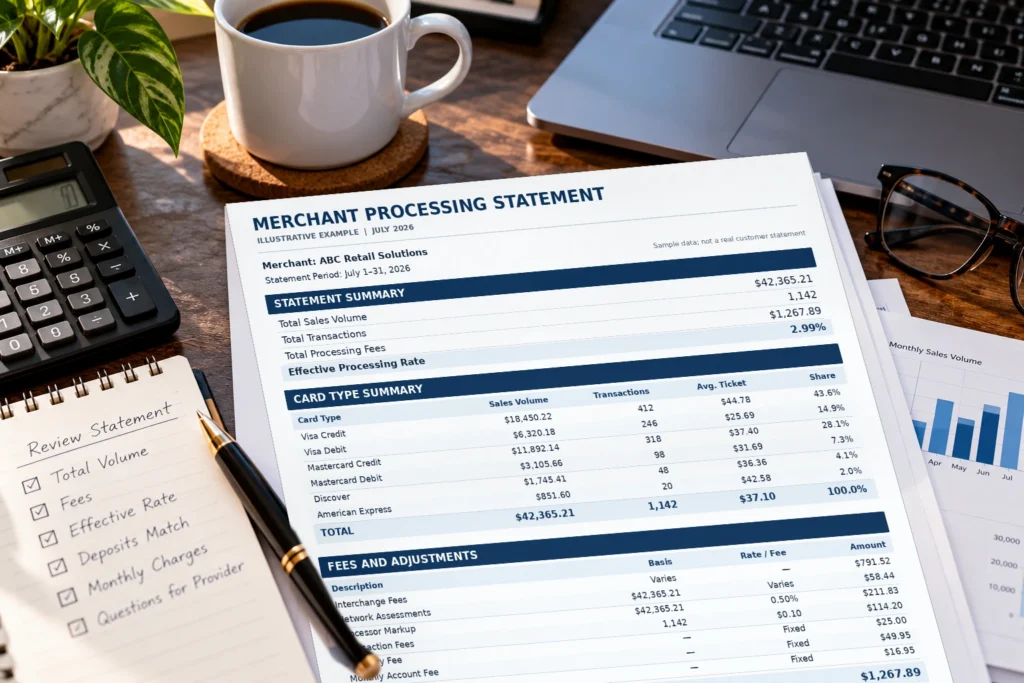

A credit card processing statement shows what your business processed, what you paid in fees, and how the resulting funds moved into your bank account. To read it correctly, start with five figures: card sales volume, transaction count, processing charges, other account expenses, and funded deposits.
Then follow the transactions from the original sale through processing fees, refunds, settlement adjustments, and bank funding. This seven-step process helps you verify the charges instead of relying only on the processing rate you remember being quoted.
Unfortunately, merchant statements aren’t always easy to understand. One provider may list dozens of interchange categories, while another combines charges into a smaller number of pricing tiers. Some providers deduct fees daily, and others bill them at the end of the month.
Since co-founding Valued Merchant Services in 2006, I’ve helped business owners examine processing statements and understand the amounts they’re paying. Sometimes a review reveals a charge worth questioning. Other times, it shows that the existing arrangement is already competitive.
Either outcome is useful. The purpose of learning how to read a credit card processing statement is to make an informed decision, not to assume that every business needs a different processor.
This guide explains seven practical steps, with fee calculations, a historical VMS statement example, pricing-model comparisons, deposit reconciliation, and guidance for understanding Form 1099-K.
How to Read a Credit Card Processing Statement: Quick Answer
The Seven-Step Statement Review
- Verify your account and dates. Identify the merchant account and statement period.
- Check sales and transactions. Record gross card sales, refunds, net volume, and transaction count.
- Review your card mix. Identify credit, debit, card brands, and payment channels where available.
- Find transaction fees. Review interchange, network charges, processor markup, and related items.
- Identify other charges. Look for account, gateway, software, equipment, and incidental fees.
- Calculate the effective rate. Divide the appropriate total fees by the corresponding card volume.
- Reconcile your deposits. Explain the differences between card sales, settlement activity, and bank funding.
Statement labels and billing methods vary. An unfamiliar charge is not automatically improper, and not every merchant pays every type of fee.
Seven Steps to Understand Your Credit Card Processing Statement
For your first review, gather the complete monthly statement, the applicable merchant agreement or pricing schedule, and the related bank deposit records.
If your POS or payment gateway provides separate batch and transaction reports, have those available as well. The additional detail will help you distinguish fee differences from refunds and settlement timing.
Step 1: Confirm the Account and Reporting Period
Start with the statement header. Confirm the legal merchant name, location, merchant account identifier, processing provider, and reporting dates.
Businesses with separate in-person, ecommerce, or location-specific merchant accounts may receive several statements. Review each one separately before combining results.
In addition, remember that a sale completed at the end of a month may settle or fund in the next reporting period. Your POS sales date, processor settlement date, and bank funding date may differ.
Record: Merchant account, business location, processor, and beginning and ending dates.
Step 2: Find Card Sales, Refunds, and Transaction Count
Next, find the sales summary or card activity section of your credit card processing statement.
Common labels include gross sales, processed volume, settled volume, refunds, credits, net sales, transaction count, and average ticket.
These numbers are related, but they’re not necessarily interchangeable.
Gross Sales Versus Net Sales
Gross card sales generally represent applicable purchases before refunds. Net sales may subtract refunds or other adjustments, depending on the processor’s reporting definition.
Therefore, record which volume figure you’re using. When comparing rates between months or providers, apply the same definition consistently.
Why Transaction Count Matters
Suppose two businesses each process $20,000 in card payments during a month.
Business A completes 200 transactions averaging $100. Business B completes 1,000 transactions averaging $20.
At a hypothetical $0.10 per-item charge, Business A pays $20 in those charges, while Business B pays $100.
Although the sales volumes are identical, the fixed transaction costs differ by $80.
Record: Gross sales, refunds, net volume, completed transactions, and average ticket.
Step 3: Review Card Brands and Payment Channels
Your statement may break down payments by Visa, Mastercard, American Express, Discover, debit, credit, and other categories.
It may also distinguish in-person chip or contactless transactions from ecommerce, telephone orders, and manually entered card payments.
These distinctions matter because processing costs depend on factors such as card category, transaction characteristics, merchant classification, and contractual pricing.
For example, an eligible debit transaction can have a different underlying fee from a rewards credit-card purchase. Likewise, a manually entered transaction may differ from a properly submitted chip transaction.
For additional context, see our debit versus credit card processing guide.
Record: Available volume and transaction counts by card type, brand, and payment channel.
Step 4: Identify Interchange, Network Fees, and Processor Markup
This part of a credit card processing statement explains where much of the transaction-related expense comes from.
Interchange
Interchange is a component of card acceptance economics associated with the issuer and acquiring relationship.
Visa and Mastercard publish interchange schedules that vary by applicable card and transaction characteristics. For merchants, interchange generally forms part of the acquiring or merchant discount charges, rather than a direct payment made separately to an issuing bank.
Payment-Network Charges
Card networks establish applicable assessments and other charges. Depending on the fee, the calculation may involve a percentage, an item count, or additional transaction characteristics.
Processor Markup
A processor may charge a percentage markup, a per-item amount, or other pricing under the merchant agreement.
Interchange-plus statements often show more of these components separately. By contrast, bundled or flat-rate statements may combine multiple costs into one price.
See Mastercard’s merchant interchange resources and Visa’s U.S. interchange and fee information.
Record: Interchange, available network charges, processor percentage markup, and fixed transaction charges.
Step 5: Identify Monthly and Incidental Fees
A complete review includes more than transaction rates. Look for additional charges such as:
- Monthly merchant account or service fees
- Payment gateway or virtual terminal fees
- POS software subscriptions
- Terminal rentals or equipment service charges
- Authorization, batch, or settlement fees
- PCI-related program or noncompliance fees
- Reporting or statement charges
- Dispute and chargeback-related fees
- Monthly minimum charges
- Other contractual or occasional expenses
Not every item belongs in the same comparison.
For example, a POS software subscription may provide inventory and reporting functions in addition to payment acceptance. Include it when comparing total payment-system costs, but distinguish it from transaction processing charges.
Similarly, an unusual one-time dispute or equipment charge should not be treated as a normal monthly cost without explanation.
Record: Charge amount, description, frequency, business purpose, and contractual basis.
Step 6: Calculate the Effective Credit Card Processing Rate
Once you’ve identified the applicable fees and volume, calculate the effective rate using a consistent definition.
Effective Processing Rate Formula
(Applicable Fees ÷ Corresponding Card Sales Volume) × 100
For example, $600 in processing charges divided by $20,000 in corresponding card sales equals an effective rate of 3.00%.
However, an all-in calculation that includes gateway, software, or equipment expenses is different from a processing-only effective rate. Label the calculation clearly.
Refunds, unusual one-time charges, and changes in card mix may also affect a single month’s percentage. For that reason, comparing several months can be more informative than focusing on one period.
Record: The fee categories included, the corresponding sales volume, and the calculated percentage.
Step 7: Reconcile the Statement With Bank Deposits
Finally, compare your processor’s settlement reports with the funds that actually reached your bank account.
Account for refunds, dispute debits, processing-fee deductions, reserve withholding, other adjustments, and differences in funding dates.
Some providers deduct charges before depositing settlements. Others fund transactions first and withdraw fees later. Certain arrangements combine both methods.
Therefore, do not count a fee twice simply because it appears in the processing statement and in a bank withdrawal report.
Also, reserve withholding reduces cash immediately available to the business but is not necessarily a permanent processing expense.
Record: Settlements, adjustments, withheld funds, deposit dates, funded amounts, and separately debited fees.
Credit Card Processing Statement Example: Interchange-Plus Pricing
Let’s work through a complete hypothetical statement to show how fees add up.
Assume a small business processes $30,000 across 600 transactions. Every rate below is selected for illustration, not presented as a current Visa, Mastercard, VMS, or industry-average rate.
Part 1: Calculate the Illustrative Interchange
| Card category | Volume | Transactions | Assumed rate | Fee |
|---|---|---|---|---|
| Visa credit | $16,000 | 320 | 1.80% + $0.10 | $320.00 |
| Visa debit | $8,000 | 200 | 0.75% + $0.15 | $90.00 |
| Mastercard credit | $6,000 | 80 | 1.90% + $0.20 | $130.00 |
| Total | $30,000 | 600 | Illustrative | $540.00 |
Here’s how those fees were calculated:
- Visa credit: $16,000 × 1.80% = $288, plus 320 × $0.10 = $32. Total: $320.
- Visa debit: $8,000 × 0.75% = $60, plus 200 × $0.15 = $30. Total: $90.
- Mastercard credit: $6,000 × 1.90% = $114, plus 80 × $0.20 = $16. Total: $130.
The combined illustrative interchange is $540.
Real interchange statements usually contain more categories because payment-network classifications depend on additional transaction details.
Part 2: Add Network, Processor, and Account Charges
| Fee | Calculation | Amount |
|---|---|---|
| Interchange | Category detail above | $540.00 |
| Network assessments | $30,000 × 0.13% | $39.00 |
| Processor percentage markup | $30,000 × 0.25% | $75.00 |
| Processor per-item markup | 600 × $0.10 | $60.00 |
| Monthly account fee | Fixed charge | $20.00 |
| Gateway subscription | Fixed charge | $15.00 |
| Total fees | All listed charges | $749.00 |
Transaction-related interchange, network charges, and processor markup total $714. The monthly account fee and gateway subscription add another $35.
Therefore, the total listed processing and payment-service fees equal $749.
Part 3: Calculate the All-In Fee Percentage
Illustrative Total Fee Percentage
Card sales: $30,000
Listed fees: $749
Calculation: ($749 ÷ $30,000) × 100
2.50%
Rounded from approximately 2.4967%. This calculation includes the hypothetical monthly account and gateway fees, so it is an all-in percentage for the listed charges, not a current processing quote.
This example shows why a processor’s advertised percentage markup is not the same as the merchant’s total effective rate.
The 0.25% markup is just one component of the $749 total.
How Different Credit Card Processing Statement Pricing Models Compare
Interchange-plus, flat-rate, and tiered pricing can produce different statement layouts and costs. However, no model is automatically cheapest for every business.
Interchange-Plus
Interchange-plus pricing generally separates interchange and processor markup, while network and other account charges may appear separately.
It can make the underlying costs more visible, although the statement may be more complex.
Flat-Rate Pricing
A flat-rate plan may combine multiple underlying costs into a set merchant-facing rate, sometimes with an additional per-transaction fee.
For example, suppose the same $30,000 and 600 transactions are priced at a hypothetical 2.60% plus $0.10 per transaction.
$30,000 × 2.60% = $780. The 600 transaction fees add $60. Total: $840, or 2.80%, before any extra services.
Tiered Pricing
Tiered pricing groups transactions into merchant-facing categories, often called qualified, mid-qualified, and non-qualified.
These categories should not be mistaken for universal card-network interchange classifications.
For an illustrative tiered statement, assume:
- $20,000 at 2.20% = $440
- $8,000 at 3.20% = $256
- $2,000 at 4.20% = $84
- 600 transactions at $0.10 each = $60
- Monthly account fee = $20
Total: $860, or approximately 2.87% of $30,000 in card sales.
Compare the Three Illustrative Statements
| Pricing model | Listed fees | Percentage of sales |
|---|---|---|
| Interchange-plus | $749 | 2.50% |
| Flat-rate | $840 | 2.80% |
| Tiered | $860 | 2.87% |
All three examples are hypothetical and use different assumed pricing terms. They do not prove that interchange-plus always costs less. Compare actual proposals using the same card mix, volume, transaction count, and required services.
For more about common statement and fee structures, consult Chase Payment Solutions’ statement guidance.
Real Figures From a Historical VMS Processing Statement
Now let’s examine an actual published document rather than another invented example.
Valued Merchant Services previously published a two-page sample cash-discount merchant statement dated January 2018. Its figures illustrate the relationship between settled sales, transaction counts, daily fee deductions, and a separate month-end charge.
View the historical VMS sample processing statement.
Important: This is a historical sample of one pricing arrangement, not a current quote, an industry average, or a verified merchant savings case study.
What the Historical Statement Reports
| Statement field | Reported amount |
|---|---|
| Net card sales / settled volume | $66,752.35 |
| Transactions | 1,518 |
| Average ticket | $43.97 |
| Daily discount and fees | $2,002.57 |
| Additional month-end fee | $25.00 |
| Total listed fees | $2,027.57 |
| Net after listed fees | $64,724.78 |
Calculate the Historical Effective Fee Percentage
The statement reports $2,002.57 in daily discount and fees and another $25 month-end account charge.
$2,002.57 + $25 = $2,027.57.
Next, divide that total by the reported settled volume:
Historical Sample Effective Fee Percentage
($2,027.57 ÷ $66,752.35) × 100
3.04%
Rounded to two decimal places. This calculation uses the sample’s total listed fees and reported settled volume, not current VMS processing prices.
The sample also shows a 3.000% discount rate on its listed card categories. The separate $25 account charge raises the overall calculated percentage to approximately 3.04%.
This demonstrates why the advertised or transaction-level rate may differ from the overall cost.
Reconcile the Historical Deposits
The sample reports aggregate proceeds of $64,749.78 after daily discount deductions.
$66,752.35 − $2,002.57 = $64,749.78.
After the separate $25 month-end charge:
$64,749.78 − $25 = $64,724.78.
The sample identifies both daily funding totals and the month-end figure. Therefore, the $64,724.78 should not be misrepresented as one individual bank deposit.
What This Historical Example Cannot Prove
Because the statement illustrates a cash-discount arrangement, it does not independently establish how much processing cost the merchant ultimately absorbed after considering customer-facing prices.
It also does not prove savings compared with another provider.
Those questions would require information about the merchant’s prices, actual customer transactions, applicable requirements, and alternative processing arrangements.
Use the sample to learn reconciliation, not to assume a universal merchant rate or savings amount.
How to Verify Charges on a Credit Card Processing Statement
A useful statement review goes beyond reading fee descriptions. It checks whether the calculations agree with the relevant activity and contractual terms.
Verify a Percentage-Based Fee
Multiply the applicable volume by the percentage written as a decimal.
Example: $10,000 × 0.40% = $40.
If the amount doesn’t match, confirm the fee’s calculation base, reporting period, and any conditions that affect it.
Verify a Per-Transaction Charge
Multiply the eligible item count by the fee per item.
Example: 400 transactions × $0.15 = $60.
However, an authorization fee may apply to attempted requests rather than only completed sales. Batch, refund, and decline-related fees may also use different counts.
Verify a Percentage Plus a Per-Item Charge
Suppose a provider charges 0.20% plus $0.10 per eligible transaction.
On $25,000 and 500 eligible transactions:
- $25,000 × 0.20% = $50
- 500 × $0.10 = $50
- Total = $100
If the statement shows $115, ask which additional fees or activity explain the $15 difference.
Check Interchange and Network Charges
Actual interchange schedules contain numerous categories. You may need detailed transaction reports to reconstruct the charges accurately.
Request the relevant reports from your processor instead of guessing based on the category names alone.
Bank of America’s interchange and network fee schedules provide an example of the types of information providers may publish.
Compare Fee Changes With Your Agreement
If a charge increases, compare the current and prior statements with the applicable pricing agreement or notice.
The cause could be a processing-rate change, new network charge, different card mix, additional online transactions, new software service, or an incidental fee.
Not every increase is improper. However, the provider should be able to explain the calculation and contractual basis.
How to Reconcile Credit Card Sales to Net Bank Deposits
Fee analysis explains the cost of accepting cards. Deposit reconciliation explains how sales and settlement adjustments translated into cash received.
These are related but distinct questions.
A Hypothetical Gross-to-Net Reconciliation
Return to the earlier $30,000 example. For simplicity, assume all the following activity belongs to the same reconciliation period.
| Activity | Amount |
|---|---|
| Gross card sales | $30,000.00 |
| Less refunds | ($1,200.00) |
| Less chargeback principal | ($250.00) |
| Less reserve withheld | ($500.00) |
| Less daily processing deductions | ($714.00) |
| Aggregate funded settlements | $27,336.00 |
| Less separate monthly fee debit | ($35.00) |
| Net cash after listed activity | $27,301.00 |
$30,000 − $1,200 − $250 − $500 − $714 − $35 = $27,301.
The $714 deducted through settlements and the $35 withdrawn separately total $749, matching the earlier fee example.
However, not every deduction represents a processing fee.
Refunds Are Not Processing Charges
The $1,200 refund returns previously collected sales money to customers. It reduces net proceeds but should not automatically be counted as a $1,200 processing expense.
Any separate refund fee needs its own classification.
Disputed Principal Differs From a Chargeback Fee
The $250 chargeback principal reflects disputed transaction funds removed or withheld through the dispute process.
An administrative dispute fee, if charged, would be an additional item.
For more guidance, read our chargeback prevention guide.
Reserve Withholding Isn’t Automatically an Expense
The $500 reserve reduces immediately available cash. Depending on the agreement and release conditions, the merchant may retain a contractual claim to those funds.
Therefore, it should not automatically be treated as a permanent processing expense.
Avoid Double-Counting Daily and Monthly Fees
In the example, $714 was deducted before funding, while $35 was withdrawn separately.
Both belong in the total fee analysis, but only once each.
Allow for Reporting and Funding Date Differences
Actual sale, settlement, dispute, and deposit dates may cross calendar periods.
Use processor settlement references and bank funding records to match activity rather than assuming everything falls on the same day.
For a detailed example of the reports involved, see Bank of America’s merchant statement reconciliation instructions.
Credit Card Processing Statement Fee Glossary
Different providers use different terminology. The following definitions help explain common merchant statement entries.
| Statement term | Meaning or question to ask |
|---|---|
| Interchange | Issuer-related component of acquiring economics. Which categories generated it? |
| Network assessment | Fee under applicable card-network rules. How is it calculated? |
| Processor markup | Additional processor pricing. Is it a percentage, per-item charge, or both? |
| Authorization fee | Charge for eligible authorization requests. Are declines included? |
| Batch fee | Charge for eligible settlement batches. How many were billed? |
| Gateway fee | Charge for gateway or virtual terminal service. Is it still needed? |
| Monthly account fee | Recurring account charge. What does it cover? |
| PCI program fee | Security or compliance-related charge. What service or obligation does it address? |
| PCI noncompliance fee | Possible charge for incomplete applicable validation. What must be corrected? |
| Chargeback fee | Possible administrative dispute charge, separate from disputed principal. |
| Reserve withholding | Funds held under an agreement, not necessarily a permanent fee. |
| Qualified / non-qualified | Merchant pricing tiers. What determines each classification? |
| FANF, NABU, and other abbreviations | Possible network-related categories. Which fee schedule and calculations apply? |
The exact names and charges vary. If a fee isn’t clear, ask for a written explanation and the applicable calculation.
Why Form 1099-K May Differ From Your Processing Statement
Many business owners notice that the amount shown on Form 1099-K differs from the cash deposited into their bank accounts.
That difference is not automatically an error.
The IRS explains that Form 1099-K generally reports gross payment amounts without reducing them for processing fees, refunds, credits, or similar adjustments.
Bank deposits may already reflect some of those amounts. In addition, a Form 1099-K generally summarizes annual reportable activity, while merchant statements commonly cover individual months.
Example: Gross Reporting Versus Net Cash
Suppose a business has $30,000 in reportable card purchases during a relevant period.
Refunds, processing fees, disputes, and reserves may affect how much money eventually reaches the bank account, but those adjustments do not necessarily reduce the gross amount reported on Form 1099-K.
However, the gross reported figure should not automatically be treated as taxable profit.
Different transactions, deductions, refunds, and other accounting items may require separate treatment.
How to Reconcile Form 1099-K
Keep annual records distinguishing gross card payments, refunds, fees, disputes, reserves, adjustments, settlement dates, and bank deposits.
Then compare the annual processor reports with the Form 1099-K and your accounting records.
For current instructions, see the IRS guidance on Form 1099-K.
For tax reporting decisions, consult a qualified professional rather than assuming your net bank deposits equal taxable revenue.
Seven Processing Statement Charges Worth Investigating
An unfamiliar charge isn’t automatically incorrect, but certain patterns warrant a closer look.
1. New or Increased Fees
Compare new charges with previous statements and the pricing agreement. Ask when the change took effect and what authorizes it.
2. Higher Fees With Similar Card Volume
If activity is similar but fees increase, investigate card mix, network changes, payment channels, processor pricing, and account services.
3. Unused Services
A gateway, software plan, or equipment service may continue billing after the business no longer uses it.
Before cancellation, verify that no current integration or reporting process depends on the service.
4. Unexpected PCI Noncompliance Charges
Find out whether an applicable validation requirement remains incomplete and what must be done to address it.
A charge appearing on a statement does not, by itself, establish compliance status.
5. Transaction Fees That Don’t Match Activity
Confirm whether the fee uses completed sales, authorizations, attempted transactions, refunds, or batches.
The correct item count can differ from the monthly sales count.
6. Unexplained Deposit Differences
Ask for the settlement report, adjustment detail, and bank funding references. Match the underlying entries before drawing conclusions.
7. One-Time Charges Inflating the Effective Rate
An annual fee, unusual dispute expense, or equipment purchase can make one month appear more expensive.
Include the expense in your analysis, but separate recurring charges from one-time items.
Monthly Credit Card Processing Statement Review Checklist
Once you understand the statement format, a routine monthly review becomes much easier.
10 Questions to Review Every Month
- Does this statement cover the correct account and dates?
- Do sales and transaction counts match the processing reports?
- Are refunds and disputes identified correctly?
- Can I explain the major interchange and network costs?
- Does processor markup match the agreement?
- Have account, software, or other fees changed?
- Have I counted fees deducted from deposits correctly?
- Is my effective rate calculated consistently?
- Can I reconcile funded settlements and separate bank withdrawals?
- Which unexplained items should I ask the provider about?
A straightforward account may need only a short monthly review once its reporting format is familiar.
Businesses with multiple locations, unusual disputes, detailed interchange pricing, or several connected payment products may need additional reports and more time.
What If Your Processing Statement Still Doesn’t Make Sense?
Sometimes the main statement does not provide enough detail to explain every fee.
In that case, request the relevant supporting records, such as:
- Complete fee detail for the period
- Interchange and network charge reports, where available
- The current pricing agreement or fee schedule
- Batch settlement and funding records
- A list of recurring software and account services
- Explanations of unexpected charges or rate changes
A processing provider should be able to explain the relevant charges and the basis on which they were calculated.
How VMS Helps Merchants Understand Their Processing Statements
Valued Merchant Services has helped businesses evaluate payment-processing arrangements since 2006.
We offer a free, no-obligation review of an existing merchant processing statement, including processing volume, fee structures, recurring charges, equipment, and relevant services.
Rather than looking only at one advertised percentage, we consider the merchant’s actual requirements and the potential consequences of changing providers.
For example, an apparent rate reduction may not be worthwhile if it requires replacing useful POS software or introduces other significant costs.
Sometimes a different arrangement makes sense. Other times, the current provider is already a good fit.
We believe a merchant should understand the numbers before making that decision.
Want a Second Opinion on Your Processing Statement?
Valued Merchant Services offers a free statement review. We’ll help explain your effective rate, transaction charges, recurring fees, and available options. If your current arrangement makes the most sense, we’ll tell you that too.
Request Your Free Processing Rate Review
Questions? Call 800-531-8575 or email support@valuedmerchants.com.
The review is free, with no obligation to switch. Pricing, equipment compatibility, program eligibility, and any possible savings depend on your business and its processing arrangement. Submit sensitive statements only through an appropriate secure process.
Frequently Asked Questions About Credit Card Processing Statements
How do I read a credit card processing statement?
Confirm the reporting period, card volume, transaction count, refunds, processing fees, account charges, and deposit activity. Check the calculations, determine your effective rate, and reconcile the statement with bank records.
What is the most important number on my merchant statement?
No single number tells the whole story. Card sales volume, total fees, the effective rate, and funded deposits measure different aspects of the account.
How do I calculate my effective processing rate?
Divide the relevant total fees by the corresponding card sales volume and multiply by 100. For example, $600 in fees on $20,000 in card sales equals 3.00%. Be consistent about which fees you include.
Why is my effective rate higher than the rate I was quoted?
The quoted percentage may describe only processor markup or one transaction category. Interchange, network charges, per-item fees, monthly services, and card mix can affect the final result.
Are interchange and processor markup the same thing?
No. Interchange is one underlying component of card acceptance economics. Processor markup is an additional pricing component. Bundled plans may combine them into one merchant-facing rate.
What does discount rate mean?
The term depends on the provider and pricing structure. It generally describes a percentage-based processing charge, but the statement or agreement should clarify which costs it includes.
What’s the difference between daily and monthly discount?
Daily-discount arrangements generally deduct applicable fees as transactions settle. Monthly arrangements bill some or all charges later. Certain providers use both.
Why don’t merchant deposits equal card sales?
Deposits can reflect refunds, disputes, fees, reserves, adjustments, and timing differences. Compare settlement reports with the bank activity for the relevant period.
Does interchange-plus mean there are no other fees?
No. Additional network, account, gateway, software, equipment, and incidental charges may apply under the agreement.
Why does Form 1099-K show more than my deposits?
Form 1099-K generally reports gross payment amounts before fee, refund, and similar adjustments. Bank deposits may already reflect those deductions. Reconcile the records and obtain qualified tax guidance as needed.
Can I compare processors using advertised rates alone?
Not reliably. Compare equivalent volume, transaction count, card mix, pricing classifications, fees, software, equipment, and contractual terms.
Will VMS review my statement without requiring me to switch?
Yes. VMS offers a free, no-obligation statement review. If the existing arrangement already meets the business’s needs, we’ll explain that rather than recommend an unnecessary change.
Final Thoughts: Understand the Numbers Before Switching Processors
Learning how to read a credit card processing statement gives business owners more control over an important recurring expense.
You don’t have to memorize every interchange category. Instead, start with the fundamentals: identify the correct volume, review the transaction counts, understand the fees, verify the calculations, and reconcile the deposits.
Then compare the results over time.
A careful review may reveal charges worth questioning. It may also confirm that you’re paying appropriate fees for services your business genuinely uses.
After two decades in merchant services, I believe the best outcome is an informed business decision, not a processor change simply for the sake of switching.
Know what you’re paying, understand why you’re paying it, and decide whether your processing arrangement still fits your business.
Sources and Additional Reading
This guide draws on payment-industry documentation, IRS guidance, and a historical VMS statement:
- Chase Payment Solutions: Merchant Statements and Fees
- Bank of America: Merchant Statement Reconciliation
- Bank of America: Interchange and Network Fees
- Mastercard: Merchant Interchange Rates
- Visa: Interchange Reimbursement Fees and Rules
- IRS: What to Do With Form 1099-K
- Valued Merchant Services: Historical Sample Cash-Discount Statement
Updated November 2026. For educational purposes only. All examples labeled hypothetical are mathematical illustrations, not current processing quotes or market averages. Processing terms, statement formats, network fees, and account arrangements vary. The historical example illustrates reported fees and settlement reconciliation, not guaranteed savings. For account-specific questions, consult your processing provider and signed agreement. Tax information is general and does not replace professional advice.
