
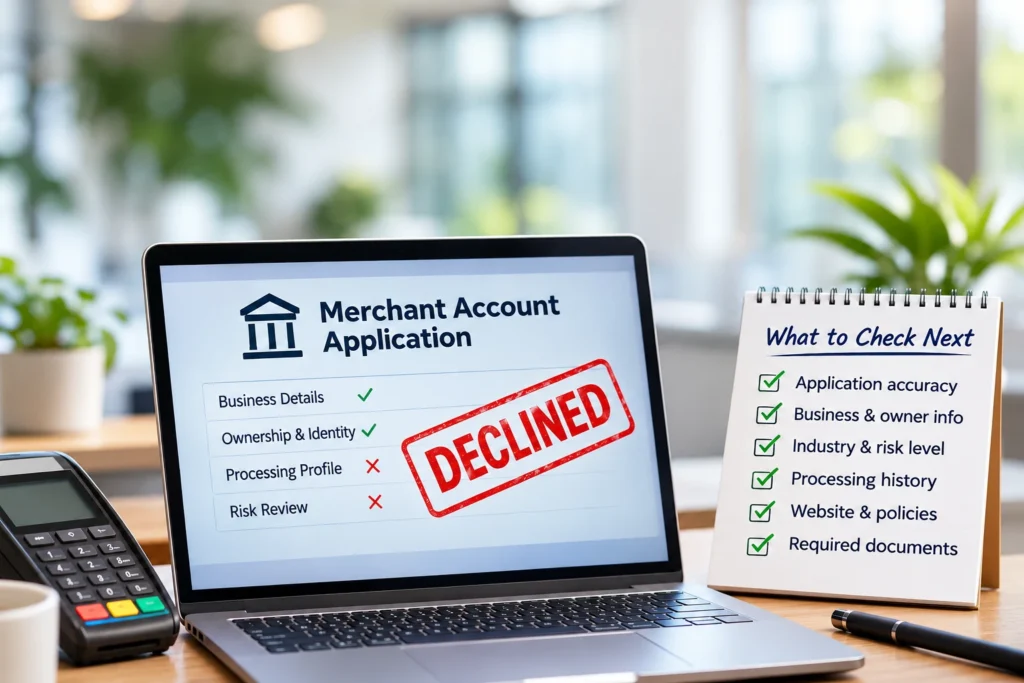

Merchant account declined? The next step is to find out whether the problem involves missing information, business eligibility, financial risk, previous processing history, or something the payment provider cannot support. Some application problems can be corrected with accurate documentation. Others require a different underwriting program or a change in business practices. And some declines cannot be resolved simply by submitting another application.
A merchant account application declined by one provider is not automatically a permanent rejection from every payment processor. However, approval elsewhere is never guaranteed.
Since co-founding Valued Merchant Services in 2006, I’ve learned that the most productive response to an underwriting problem is to understand what the processor is evaluating before deciding what to do next.
A business may have legitimate operations, real customers, and strong sales, yet still fall outside a particular provider’s acceptance criteria. Conversely, an apparently routine application may raise legitimate questions because its information does not match the business’s actual activities.
This guide explains why merchant account applications get declined, how to recognize common underwriting concerns, what a business owner can correct, and when another processing arrangement might be appropriate.
Merchant Account Declined? The Quick Answer
What to Do After a Merchant Account Decline
- Confirm the status. Determine whether the application was declined, remains pending, or needs additional information.
- Ask for the reason. Request as much specific information as the provider can appropriately share.
- Verify the application. Check business ownership, identity, banking details, business description, and projected processing activity.
- Identify the risk concern. Review chargebacks, financial condition, delivery times, industry restrictions, and any prior account termination.
- Correct factual problems. Submit accurate supporting evidence through the provider’s secure process.
- Review possible alternatives. Ask whether reconsideration or an appropriate different acquiring program is available.
- Evaluate the terms. Understand fees, reserves, funding, contracts, and technical compatibility before accepting another offer.
A decline does not establish that every payment provider will reject the business. It also does not establish that another provider can approve it.
Why Do Merchant Account Applications Get Declined?
Merchant account applications get declined when the acquiring institution or processing provider determines that the business cannot be approved under the applicable underwriting requirements.
The decision may involve the merchant’s identity, financial condition, industry, business practices, transaction history, expected sales, or compliance with payment-network and provider rules.
Underwriting is not simply a check of whether a business owner has good credit.
Payment providers also consider the financial exposure they may face if customer payments need to be refunded, disputed, or reversed after the merchant has already received funds.
The Office of the Comptroller of the Currency discusses business legitimacy, financial condition, processing history, industry classification, and merchant risk in its Merchant Processing handbook.
Visa likewise describes merchant qualification, prohibited activities, business validation, and underwriting policies in its Payment Facilitator and Marketplace Risk Guide.
These resources establish why underwriting matters. However, they do not create a universal approval checklist that every processor applies identically.
Merchant Account Declined, Pending, or Conditionally Approved?
Before responding, verify which decision the provider actually made.
| Application status | What it generally means | Appropriate next action |
|---|---|---|
| Pending review | Underwriting has not completed its decision. | Confirm what remains outstanding and provide requested information. |
| Additional information required | The provider needs clarification or documents. | Correct or complete the file accurately. |
| Conditional approval | The provider may accept the account subject to specified terms. | Review conditions, limits, reserves, and agreements before proceeding. |
| Declined | The current application was not accepted. | Ask why and assess reconsideration or other legitimate options. |
For example, an application waiting for a bank verification document is not necessarily declined.
Likewise, an offer that includes a reserve or monthly processing limit is not the same as unconditional approval.
Clarifying the status prevents unnecessary resubmissions and helps the business address the actual problem.
8 Common Reasons a Merchant Account Application Gets Declined
1. Incomplete or Inconsistent Business Information
A merchant account can be declined or delayed when important details are missing, inaccurate, or inconsistent.
Potential issues include differences between:
- The legal business name and registration records
- The stated business address and supporting documents
- The tax identification information and application
- The owner information and identification documents
- The bank account title and the business information
- The described products or services and the business’s website
Not every discrepancy means someone has provided false information.
For example, an established business might operate under a registered trade name that differs from its legal entity name. That is common, but the relationship should be explained accurately.
What to check next: Compare the application against official registration records, bank documentation, identification, and the actual business operation. Correct factual errors instead of guessing what the underwriter wants to see.
2. The Provider Cannot Verify Ownership or Identity
Payment providers and their financial institution partners may need to establish that the applicant represents a legitimate business and has authority to open the account.
Depending on the program, underwriting may involve verifying individuals who own or control the business and checking information against applicable legal and risk requirements.
Problems may arise when identification documents are unreadable, ownership details conflict, authorized-signatory information is incomplete, or the business structure is not adequately explained.
What About Beneficial Ownership Requirements?
Some financial institutions have customer due diligence obligations related to identifying legal-entity customers and their beneficial owners.
FinCEN granted exceptive relief in February 2026 allowing covered institutions, under specified conditions, to avoid repeating beneficial-owner identification and verification at every subsequent account opening.
However, the change did not eliminate all identity verification or ongoing risk-based customer due diligence responsibilities. Covered institutions may also maintain procedures that go beyond the relief’s minimum conditions.
For current requirements, see FinCEN’s Customer Due Diligence Rule FAQs.
What to check next: Ask which identity or ownership information is required for the actual account and provide it through a verified, secure submission process.
3. The Business Category Falls Outside the Provider’s Acceptance Policy
Some processors do not support certain business models, products, or services under their acquiring relationships.
Other providers may accept a category only after enhanced underwriting or with additional conditions.
Being classified as higher risk is not the same as operating an unlawful business.
However, a lawful business can still be outside a particular provider’s approved merchant categories.
For example, certain models involving extended future delivery, recurring customer obligations, specialized products, or complex regulatory requirements may trigger additional review.
What to check next: Ask whether the decline resulted from an absolute prohibition, an unsupported merchant category, or a risk issue that can be evaluated under another appropriate program.
Our separate guide to high-risk merchant classifications explains those distinctions in more detail.
4. Weak Financial Condition or Credit Concerns
Merchant account underwriting may consider the financial ability of the business to meet obligations related to refunds, chargebacks, and other processing losses.
Depending on the provider and program, a review may include business financial information, bank records, prior processing data, or legally permissible credit information.
However, a low personal credit score does not create one universal outcome across every merchant processing program.
Different providers assess financial risk differently.
What to check next: Confirm whether the concern relates to a credit report, insufficient financial information, operating losses, outstanding obligations, or another specific issue.
Where appropriate, provide accurate financial documentation and ask whether a different authorized program or conditional arrangement may be available.
5. Chargebacks, Fraud History, or Previous Processing Problems
Processors consider previous transaction disputes and payment-processing losses because they may indicate potential future exposure.
For example, a business with repeated customer disputes related to delayed delivery may attract additional review.
That doesn’t mean every chargeback establishes misconduct.
Some disputes arise from customer confusion, refund delays, unclear billing descriptions, or operational problems.
However, significant unresolved disputes or prior violations can materially affect underwriting.
What to check next: Gather accurate processing statements, dispute records, refund activity, and evidence of any corrective changes.
If the business has improved delivery procedures or customer communication, explain those changes truthfully and document them when possible.
Our chargeback prevention guide covers preventive controls rather than the underwriting decision itself.
6. The Website, Sales Process, or Fulfillment Model Is Unclear
An ecommerce or service business may receive additional scrutiny if the provider cannot understand what customers purchase, how orders are fulfilled, or how refunds work.
Issues may include:
- Products or services that are poorly explained
- Unclear prices or billing arrangements
- Missing or confusing cancellation terms
- Unclear delivery or fulfillment timeframes
- Customer support information that is difficult to find
- Differences between the website and application description
- Checkout or recurring billing practices requiring further review
These factors matter because disputes can arise when customers misunderstand what they bought, when they will receive it, or how to request a refund.
What to check next: Make the website and customer policies accurate and understandable. Provide the underwriter with the actual sales and delivery process, not a more favorable description that leaves out important details.
7. Processing Volume, Ticket Size, or Future Delivery Exposure Is Too High
A merchant’s expected transaction activity can affect the financial exposure a payment provider is willing to accept.
For example, a business that collects large advance payments for services scheduled many months later may create more future refund or dispute exposure than one completing services immediately.
The same issue can arise when average transaction amounts or monthly volume are substantially larger than expected for the stated business model.
Processors may ask for financial statements, fulfillment details, customer contracts, or supporting processing history.
What to check next: Provide realistic projections of monthly card volume, largest expected transaction, average sale, and time between payment and delivery.
Do not deliberately understate transaction amounts to obtain approval. Significant differences between disclosed and actual activity can create problems after activation.
8. Prior Merchant Account Termination or Risk Screening Results
A previous merchant account termination may raise questions during a new application, particularly when the termination involved fraud, significant disputes, security violations, or other specified risk events.
Payment networks maintain systems that help acquiring institutions assess certain previously terminated merchant relationships.
A processor’s reference to a terminated merchant file may require additional investigation, but not every closed merchant account results in such a record.
What to check next: Ask whether the decision involves previous account termination information, what can be disclosed about the record, and which institution should be contacted to address an error or obtain clarification.
See the dedicated MATCH Pro explanation below.
Merchant Account Declined: Match the Problem to the Next Step
These examples show why different underwriting concerns require different responses.
| Possible issue | Useful evidence | Reasonable next step |
|---|---|---|
| Business information mismatch | Registration, tax, and banking records | Request correction or reconsideration |
| Ownership cannot be verified | Valid identity and ownership documents | Complete the required verification |
| Unsupported industry or business model | Accurate business description and relevant authorizations | Ask whether an eligible program exists |
| Financial or credit concern | Requested financial statements or supporting records | Clarify risk concerns and permitted terms |
| Excessive disputes | Processing and chargeback records, corrective policies | Address root causes and disclose history |
| Unclear website or fulfillment | Accurate policies, product pages, delivery information | Correct omissions and explain operations |
| Large future-delivery exposure | Fulfillment schedules, contracts, financial capacity | Review limits or eligible underwriting conditions |
| Prior termination or MATCH Pro concern | Termination details and available supporting evidence | Work with the relevant acquirer on the record |
These are possible diagnostic approaches, not promises that any particular document will produce approval.
What Should You Do Immediately After a Merchant Account Decline?
Step 1: Ask the Provider to Clarify the Decision
Start by confirming the actual application status.
Then ask whether the provider can identify the general reason for the decline and whether reconsideration is possible.
Some institutions may have limits on what they can disclose because of internal risk controls, confidential reviews, or legal restrictions.
However, you can still request information about any missing documentation, incorrect details, or supported next steps.
Step 2: Review the Exact Application That Was Submitted
Obtain a copy of the completed application and related terms where available.
Compare the information against your current business documents and actual operations.
Pay special attention to the business category, owners, bank account, website, transaction estimates, refunds, delivery terms, and previous processing history.
Do not silently change the information to make it appear lower risk.
Step 3: Separate Fixable Errors From Eligibility Restrictions
Some issues involve factual mistakes, missing documents, or explanations the provider can evaluate.
Other issues involve a prohibited category or risk profile the current acquiring relationship does not support.
That distinction determines whether the next step should be a corrected submission or a discussion about a different legitimate program.
Step 4: Build a Complete and Accurate Supporting File
Organize requested information so the next underwriter can understand the business without repeatedly requesting the same details.
For example, include a concise business description, relevant registration documents, realistic transaction estimates, and explanations of any material changes since a previous processing issue.
Use approved secure submission channels for identity documents, financial records, and other confidential information.
Step 5: Ask Whether Reconsideration Is Available
If the initial decision involved an error or incomplete information, a provider may be willing to review the corrected file.
However, not every decision can be appealed, and additional documentation does not guarantee reconsideration or approval.
Ask about the actual process rather than assuming the sales representative can override underwriting.
Step 6: Evaluate an Appropriate Alternative, If One Exists
Different acquiring relationships may have different merchant acceptance criteria.
Therefore, a business declined by one provider may qualify under another program.
However, a lawful and accurately disclosed business model remains essential.
Never attempt to obtain processing by using an unrelated company name, hiding restricted activities, misrepresenting ownership, or describing transactions inaccurately.
Step 7: Review the Offer Before Accepting
A new provider may offer an account with different pricing, funding schedules, processing limits, reserves, or contract requirements.
Before accepting, compare the complete arrangement with the business’s needs and financial capacity.
An approval on unsuitable terms is not necessarily a useful outcome.
What Is Mastercard MATCH Pro, and Can It Cause a Merchant Account Decline?
Mastercard MATCH Pro is a risk-information system used by participating acquiring institutions in connection with specified terminated merchant relationships.
It helps acquirers assess certain merchant risks during the onboarding process.
A MATCH Pro record may complicate a new application or require enhanced review. However, a record is not the same thing as an ordinary high-risk business classification.
It is also not a universal declaration that the merchant can never accept cards again.
Mastercard’s MATCH Pro Privacy Notice explains the system’s purpose and the responsibilities of financial institutions that contribute and maintain merchant information.
Can a Merchant Check or Correct a MATCH Pro Record?
A merchant who believes an application was affected by inaccurate terminated-merchant information should begin with the acquiring institution involved in the relevant previous account.
Ask for an explanation of the record and the appropriate procedure for addressing errors or exercising applicable information rights.
Mastercard’s rules place responsibilities on acquiring institutions for the accuracy of their MATCH Pro entries.
However, removal is not automatic simply because the merchant disagrees with the original termination.
Specific removal or correction processes depend on the reason code, supporting evidence, applicable Mastercard requirements, and the circumstances of the record.
Important: Avoid services that promise guaranteed MATCH removal, immediate deletion, or assured merchant approval without reviewing the actual record and applicable process.
Can a Merchant Account Be Approved With a Reserve or Processing Limit?
In some circumstances, an acquiring provider may offer conditional approval instead of declining an application outright.
Conditions can include a reserve, a monthly processing limit, a maximum transaction amount, additional documentation, or other risk controls.
These arrangements are not available for every business or underwriting concern.
What Is a Merchant Reserve?
A merchant reserve is a financial safeguard that may hold or retain funds according to the applicable processing agreement.
For example, a rolling reserve may withhold a specified percentage of eligible processing volume for a defined period before releasing funds under the agreement’s conditions.
Other structures may involve fixed reserve balances or upfront requirements.
The exact arrangement depends on the merchant, acquiring institution, and risk profile.
Illustrative Reserve Calculation
Suppose a hypothetical approved processing agreement requires a 5% reserve on $40,000 in eligible monthly processed sales.
$40,000 × 5% = $2,000.
Under those assumptions, $2,000 would be retained for the reserve during the month, subject to the actual contractual calculation and release conditions.
This does not mean the processor charges an additional $2,000 fee. Reserve funds and processing fees are different concepts.
However, a reserve can meaningfully affect the cash available for operating expenses.
All figures are hypothetical. Actual reserve percentages, funding methods, release schedules, and restrictions depend on underwriting and the signed agreement.
Questions to Ask Before Accepting a Conditional Approval
- What percentage or amount will be held?
- When and under what conditions can funds be released?
- Are there minimum reserve balances?
- What processing limits apply?
- Can the provider change limits or reserve requirements?
- How will the reserve appear in reporting?
- What happens to retained funds after the account closes?
- How do refunds, disputes, and outstanding obligations affect release?
A conditional approval should be evaluated against the actual needs and working capital of the business.
Three Merchant Account Decline Scenarios and What They Teach
The following examples are hypothetical illustrations of underwriting decisions. They are not presented as actual VMS customer cases or guaranteed outcomes.
Scenario 1: An Established Retailer Has Mismatched Business Records
A retail store operates under a registered trade name, but the owner submits the application using only the storefront name. The supporting bank information identifies the legal entity under a different name.
The underwriter cannot confidently reconcile the records and requests clarification.
Appropriate response: Provide accurate documentation connecting the legal entity, trade name, and bank account. Ask whether the file can be reconsidered once the discrepancy is resolved.
Lesson: A verification issue is not automatically a finding of fraud or an industry eligibility problem.
Scenario 2: A Home-Service Business Plans Large Advance Deposits
A newly established service business expects to charge customers several thousand dollars upfront for work completed months later.
The processor identifies potential future refund and chargeback exposure, particularly because the business has limited operating history.
Appropriate response: Provide truthful customer agreements, fulfillment schedules, financial information, and expected processing activity.
The business can ask whether the provider supports that model and whether an appropriate conditional arrangement exists.
Lesson: The timing between payment collection and service delivery can matter as much as sales volume.
Scenario 3: An Ecommerce Merchant Has Unexplained Dispute Activity
An online merchant seeks a new processing relationship after experiencing a period of elevated disputes.
The new provider requests earlier processing statements, refund information, and explanations of changes to customer service or fulfillment procedures.
Appropriate response: Disclose the actual dispute history, explain underlying causes, and provide accurate evidence of corrective measures.
Lesson: A merchant needs to address the factors creating processing risk, not merely search for a provider willing to overlook them.
Should You Apply to Multiple Merchant Processors After a Decline?
Submitting applications to several providers without understanding the initial decline can create unnecessary work and confusion.
It may also lead to repeated requests for sensitive information and multiple reviews that don’t address the underlying eligibility problem.
Instead, identify the reason for the first decision and determine which legitimate processing relationships, if any, support the actual business model.
If you work with a merchant services representative, ask whether the proposed provider is suitable before authorizing another application.
Then confirm which documents will be shared, how they will be protected, and whether additional credit inquiries or contractual commitments may apply.
Practical recommendation: Favor an accurate, well-prepared application submitted to an appropriate program over repeated speculative submissions.
Merchant Account Reapplication Readiness Checklist
Before applying again, use the checklist below to evaluate whether the business has adequately addressed the issue that led to the decline.
Before You Reapply
- Confirm the original application’s actual status and known reason for decline.
- Verify legal entity, trade name, tax information, address, and authorized signer.
- Confirm the bank account information belongs to the appropriate business.
- Describe products, services, payment channels, and customer policies accurately.
- Check expected monthly volume, largest transaction, and average ticket.
- Disclose applicable future-delivery, recurring-billing, or advance-payment practices.
- Review previous statements, refunds, disputes, and termination history.
- Gather any specifically requested financial or supporting records.
- Confirm the proposed provider supports the actual merchant category.
- Review reserves, fees, limits, funding, equipment, and contract conditions.
- Submit confidential documents only through a verified secure process.
- Keep copies of what you submitted and the provider’s response.
For a complete list of common initial application documents, see our merchant account requirements guide.
For timing after an application is accepted, see how merchant account setup and activation work.
Questions to Ask After a Merchant Account Application Is Declined
When speaking with an underwriting contact or merchant services representative, focus on useful information rather than asking for an unsupported approval guarantee.
- What is the current application status? Is this a final decline or an incomplete review?
- What concern can you explain? Is the issue related to documentation, eligibility, transaction risk, or another factor?
- Can the file be reconsidered? If so, what information or correction would be meaningful?
- Does your acquiring program support this business category? Are there relevant restrictions?
- Are conditional terms possible? If offered, what reserves, limits, or fees apply?
- Does any prior account record affect the decision? If so, what is the appropriate process for clarification?
- Would a different legitimate program be appropriate? What must be disclosed, and what limitations remain?
A capable representative may need to confirm certain answers with an acquiring partner or underwriting department.
That is preferable to making promises the representative cannot fulfill.
How Valued Merchant Services Helps Businesses Evaluate Their Options
Valued Merchant Services has helped business owners evaluate payment processing and merchant account arrangements since 2006.
We work with businesses across many industries and help them understand processing options, equipment, pricing, and account requirements.
When a merchant has experienced an application problem, the first useful step is understanding the available information and the actual business model.
Depending on the circumstances, our team can discuss whether a supported processing program may be worth evaluating and what documentation would likely be relevant to that review.
However, underwriting decisions belong to the applicable acquiring institution or processing provider.
We cannot guarantee approval, overturn an acquiring bank’s decision, remove a MATCH Pro record on demand, or promise that every industry can be supported.
We also won’t advise a merchant to misstate ownership, describe transactions inaccurately, or conceal material business activities to obtain processing.
Our approach remains the same: explain the options clearly, be realistic about limitations, and put people before profits.
Have Questions About a Merchant Account Decline?
If your business has encountered an application or underwriting problem, Valued Merchant Services can help you understand what information to review and discuss whether an eligible processing option may be available for your circumstances.
Contact VMS About Your Options
Call 800-531-8575 or email support@valuedmerchants.com.
No approval guarantee. Eligibility, underwriting requirements, reserves, processing limits, rates, equipment, and account terms depend on the specific business and acquiring program. Do not send Social Security numbers, bank account details, or identity documents through ordinary email without a verified secure submission arrangement.
Frequently Asked Questions About Merchant Account Declines
Why was my merchant account declined?
Common reasons include missing or inconsistent information, identity verification problems, unsupported business categories, financial concerns, previous processing issues, elevated chargebacks, fulfillment risk, or prior account termination records. The actual reason depends on the provider and application.
Can I get approved after a merchant account decline?
Possibly. If the issue involves incorrect or incomplete information, reconsideration may be available. Some businesses may qualify under a different legitimate processing program. However, no alternative provider can guarantee approval.
Does bad credit automatically cause a merchant account rejection?
No universal rule applies. Financial condition and credit information can affect underwriting, but decisions depend on the acquiring program, business characteristics, transaction history, and other relevant factors.
Can a new business get a merchant account without processing history?
Sometimes. A new business may qualify with accurate identity, business, banking, and transaction information. However, limited history can result in additional underwriting or restrictions depending on the business model.
Is a declined merchant account the same as a high-risk merchant account?
No. High-risk classification refers to underwriting characteristics of a business or transaction model. A decline means the particular application was not accepted. A higher-risk business may qualify under an appropriate program, but not every such business can be approved.
What does a MATCH Pro record mean?
MATCH Pro is a Mastercard system used by acquiring institutions to evaluate certain previously terminated merchant relationships. A record may lead to additional review or affect approval. It does not automatically mean a business is permanently prohibited from accepting cards.
Can a merchant get removed from MATCH Pro?
Correction or removal may be possible under specified rules and circumstances. The relevant acquiring institution is generally the starting point for questions about the accuracy or basis of a record. Removal is not automatic or guaranteed.
Can too many chargebacks cause a merchant account application to be declined?
Yes. Significant disputes, processing losses, fraud concerns, or related previous account problems may affect underwriting. Merchants should provide accurate history and document legitimate improvements rather than concealing past activity.
Can my website cause a merchant account application to be declined?
Potentially. An unclear business description, inconsistent products, missing customer policies, or unsupported billing and fulfillment practices may lead to additional questions or an adverse decision. Requirements differ by provider and business model.
Does a merchant account decline mean the business is illegal?
No. A legitimate business can fall outside a provider’s approved industries or financial risk tolerance. However, illegal or prohibited activities may also result in rejection. The specific reason matters.
Should I apply to several processors immediately after a decline?
Usually, it is more productive to identify the underlying issue first. Repeated applications do not necessarily solve documentation, eligibility, or prior-processing problems. Ask whether a proposed provider supports the actual business before submitting another application.
Can I be approved with a rolling reserve?
Some providers may offer conditional approval involving reserves or processing limits. Availability and terms depend on underwriting. A reserve is not a guarantee that an otherwise ineligible business will be accepted.
How long does reconsideration take after a merchant account decline?
There is no universal timeframe. A simple documentation correction may be reviewed differently from a complex financial, industry, or prior-termination issue. The provider should clarify the process and any available expectations.
Can Valued Merchant Services help after an application is declined?
VMS can discuss the circumstances, review relevant business requirements, and help eligible businesses explore appropriate merchant processing options. Final approval and terms remain subject to the applicable acquiring institution or processing provider.
Final Thoughts: Understand the Decline Before Applying Again
Having a merchant account declined can interrupt plans to launch a business, begin accepting cards, or change payment providers.
However, reacting by immediately submitting another application may not solve the underlying issue.
Start with the actual decision. Confirm what information the provider can share. Review the submitted application and identify whether the concern involves a correctable mistake, additional documentation, unsupported business activity, or financial risk.
Then determine whether reconsideration or another appropriate processing arrangement is realistically available.
Since co-founding Valued Merchant Services in 2006, I’ve believed business owners deserve clear answers, even when the answer is not the one they hoped to hear.
That matters especially when a processing application is declined.
The goal isn’t to find someone who promises approval. It’s to understand the issue, present your business accurately, and identify a legitimate payment solution that makes sense for your operation.
Sources and Additional Reading
These primary industry and regulatory resources explain merchant underwriting, verification, screening, and risk management. Their requirements apply according to the particular institution, program, and circumstances.
- Office of the Comptroller of the Currency: Merchant Processing Handbook
- Visa: Payment Facilitator and Marketplace Risk Guide
- Mastercard: MATCH Pro Privacy Notice
- FinCEN: Customer Due Diligence Rule FAQs
Published November 2026. This article provides general educational information about merchant account underwriting. Approval criteria, credit review procedures, prohibited or restricted business categories, identity verification, risk screening, reserves, and payment network rules vary by provider and may change. Hypothetical examples do not describe actual customer outcomes. Nothing in this article guarantees approval or replaces advice from the relevant financial institution or qualified professional.
