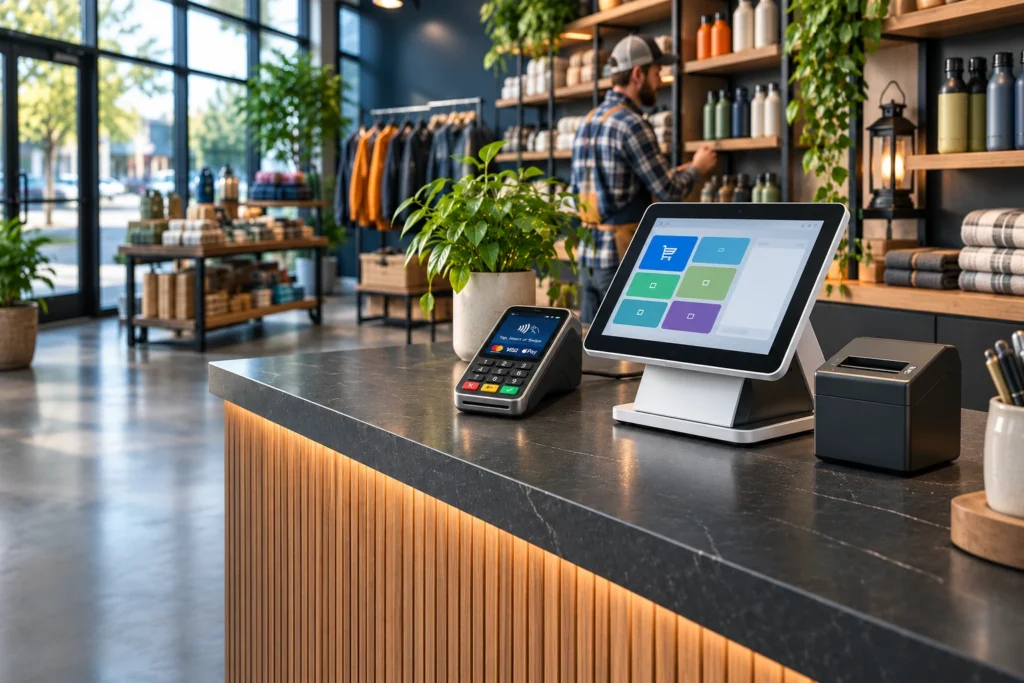

What are merchant services? Merchant services are the payment tools and related services that let a business accept, process, manage, and receive funds from customer payments. They commonly include credit and debit card processing, merchant accounts or payment-platform arrangements, card terminals, point-of-sale (POS) systems, online payment gateways, and transaction reporting. Depending on the provider, they may also include ACH payments, invoicing, recurring billing, and fraud-prevention tools.
For a small business owner, merchant services answer a practical question: How can customers pay us reliably, and how do we track the money, fees, and deposits afterward?
The answer involves more than a card reader. A successful payment depends on compatible technology, a processing relationship, financial institutions, security procedures, and an agreement that explains what the business will pay and when it will receive its money.
I’ve worked with small businesses in this industry since we founded Valued Merchant Services in 2006. One recurring lesson is that business owners benefit more from understanding the entire payment arrangement than from comparing one advertised percentage. A simple terminal can be the right answer for one merchant; another may need integrated inventory, online invoicing, or payments across multiple locations.
This guide explains what merchant services include, who handles a payment, how fees and funding work, what technology matters, and how to evaluate a provider. For a step-by-step setup checklist, see our separate guide to accepting credit card payments.
In This Guide
Merchant Services at a Glance
| Component | What it does for a business |
|---|---|
| Payment processing | Routes eligible card transactions through the required authorization and settlement systems. |
| Merchant account or payment platform | Establishes an approved arrangement to accept transactions and receive merchant funds. |
| Terminal or POS | Collects in-person payments and may support sales, inventory, orders, and reporting. |
| Payment gateway | Connects supported websites, applications, or virtual terminals to payment processing. |
| Reporting and funding | Shows sales, refunds, fees, adjustments, and deposits according to the provider’s terms. |
| Security and dispute tools | Helps protect payment data, detect possible fraud, and manage transaction disputes. |
Not every business needs every tool, and the services may come from one company or several integrated providers. The important question is whether the complete arrangement meets your business’s actual requirements.
Who Is Involved in a Credit Card Transaction?
One reason merchant services can seem complicated is that several organizations may participate in the same transaction. Their roles are related, but they are not interchangeable.
The merchant
The merchant is the business selling goods or services and accepting the payment. It is responsible for operating its checkout appropriately, presenting clear prices and policies, following its agreement, and handling customer issues.
The issuing bank
The issuer is the financial institution that issued the customer’s payment card or otherwise holds the applicable card account relationship. It evaluates authorization requests and manages the cardholder side of the payment.
The acquiring bank
The acquirer is the financial institution responsible for the merchant acquiring relationship and its role in receiving transactions, clearing, and settlement. The actual service arrangement may also involve a processor, an independent sales organization, or other providers.
The card network
Card networks, such as Visa and Mastercard, establish network rules and provide the infrastructure through which participating financial institutions exchange payment information. The network is not simply the merchant’s bank or its customer-service provider.
The payment processor and merchant services provider
A processor provides transaction-processing technology and related services within an approved arrangement. A merchant services provider may help a business obtain processing, configure equipment, review pricing, obtain support, and access additional payment products. The precise responsibilities depend on the companies and contracts involved.
The payment gateway and POS software
A gateway can connect an online checkout or compatible application to transaction processing. A POS system may combine payment acceptance with sales tools such as inventory, table management, or reporting. Neither should automatically be confused with the acquiring bank.
Visa’s payment acceptance glossary provides definitions of acquiring, authorization, and related industry terms.
How Does Merchant Services Payment Processing Work?
Consider a customer buying $80 in merchandise with a credit card. A simplified card-payment journey looks like this:
- Payment is presented. The customer taps or inserts a card at an approved terminal, or enters payment details through an authorized online checkout.
- Authorization is requested. The processing arrangement routes the transaction through the relevant systems to the card issuer, which returns an approval or decline.
- The sale is recorded. If approved, the checkout completes according to the merchant’s procedures. Approval is not the same as the money having reached the merchant’s bank account.
- Clearing and settlement occur. Transaction details are exchanged and the financial institutions handle the applicable settlement obligations.
- Merchant funding follows. The provider makes funds available under the merchant agreement, subject to its cutoff times, fees, adjustments, reserves, and any relevant holds.
This process can differ by payment method and platform. A business may see a successful card authorization immediately even though its deposit arrives later. Visa’s explanation of authentication, authorization, clearing, and settlement describes the separate stages.
Important distinction: An authorization does not guarantee that a transaction can never be disputed. Chargebacks, returns, and fraud reviews are separate processes that can affect the final amount retained by the merchant.
What Types of Merchant Services Can Small Businesses Use?
The right tools depend on where customers pay and what needs to happen after the sale.
Countertop and wireless card terminals
Standalone terminals are often sufficient for merchants that mainly need reliable card acceptance and receipts. Depending on the hardware and processing relationship, they may support EMV chip cards, contactless payments, PIN debit, and wireless connectivity. See our credit card terminal options.
Point-of-sale systems
POS platforms may add inventory management, employee access, itemized sales, restaurant ordering, appointment information, and location-level reporting. Features and software subscriptions vary widely; not every POS supports every processor. Compare functionality and ongoing costs, not just the appearance of the hardware. Our POS buyer’s guide goes deeper into these decisions.
Ecommerce and payment gateways
Online merchants may use a secure hosted checkout, integrated shopping cart, payment link, or virtual terminal connected to an appropriate payment service. A compatible gateway can help route online transactions and support features such as saved payment tokens or recurring payments where offered. Our ecommerce solutions page outlines available categories of tools.
Mobile payments and invoicing
Contractors, field-service providers, and mobile vendors may need portable terminals, supported Tap to Pay on Phone systems, or secure invoices and payment links. Connectivity, hardware compatibility, approval, and supported features should be confirmed before committing.
ACH and check-related services
ACH payments move through the Automated Clearing House Network rather than the card networks. Authorized ACH debits or credits may be useful for certain invoices, recurring obligations, and business-to-business payments. ACH has its own rules, return procedures, timing, and risks; it is not simply a cheaper version of a credit card transaction. Nacha explains the network in its ACH overview. VMS also offers check and ACH solutions for eligible businesses.
Do You Need a Merchant Account to Accept Cards?
A business needs an approved payment acceptance arrangement, but that does not always mean opening a separate, traditional merchant account in the way businesses did years ago.
Traditional merchant account
In a traditional acquiring relationship, the business typically completes an application and undergoes applicable verification and underwriting. The provider and acquirer evaluate the business, its activities, expected transactions, and other risk factors. A separate merchant identification arrangement and negotiated pricing may be part of the setup.
Payment facilitator or aggregated platform
Some payment platforms onboard eligible sellers under a payment facilitator structure. This may streamline initial signup and combine payments with software, but merchants still operate under account rules, pricing, eligibility criteria, transaction limits, and funding policies.
Neither model is automatically best. A small occasional seller may value convenience; a growing multi-location merchant may need more flexibility, reporting, or individualized support. Compare the actual agreement, payment methods, compatibility, fees, and service model.
For a detailed checklist of the information providers may request, read what you need to open a merchant account.
How Much Do Merchant Services Cost?
There is no universal processing rate that accurately describes every business. Card type, card-present versus online acceptance, merchant category, pricing model, transaction mix, and provider terms can all affect cost.
Understanding the main fee categories
- Interchange: A component of card acceptance pricing associated with the transaction and applicable network and issuer arrangements. Different transactions can qualify for different interchange rates.
- Network assessments and related charges: Fees associated with participating card networks, depending on the arrangement.
- Processor markup: The provider’s contracted charge for processing and related services, which may be percentage-based, per-transaction, monthly, or combined.
- Software and account expenses: Possible POS subscriptions, gateway charges, device costs, support programs, or other agreed services.
- Occasional charges: Potential dispute fees, special reporting charges, or other contract-defined items that do not occur with every transaction.
Not every provider separates these charges on a statement, and not every merchant has every charge. Mastercard publishes interchange rate explanations and qualification criteria, illustrating why a single advertised rate may not reflect a merchant’s actual mix of transactions.
Common processing pricing models
| Model | Typical structure | What to check |
|---|---|---|
| Flat-rate | A stated percentage and possibly a fixed transaction charge. | Which payment methods or transaction types have different rates? |
| Interchange-plus | Applicable interchange and network costs plus contracted markup. | What is the markup, and what other costs apply? |
| Tiered | Provider-defined transaction categories with different prices. | How are transactions classified, and can the provider explain the categories? |
| Cash discount or dual pricing | Different appropriately disclosed prices for payment methods under a qualifying program. | Are the displays, prices, receipts, equipment, and practices consistent with applicable law and network rules? |
Cash discount, dual pricing, and credit card surcharging are not identical. Merchants should not treat them as interchangeable or assume every arrangement is permitted in every situation. Review program eligibility, card-network rules, state law, disclosures, and equipment configuration before implementation.
Example: calculating an effective processing rate
Suppose a business has $30,000 in card sales during a month and its statement identifies $690 in processing-related transaction fees plus $30 in monthly account charges. Assume those are the only included costs for this illustration.
| Card sales | $30,000 |
|---|---|
| Transaction processing fees | $690 |
| Monthly account charges | $30 |
| Total included fees / effective rate | $720 / 2.40% |
Calculation: ($690 + $30) / $30,000 × 100 = 2.40%.
This is hypothetical math, not a VMS rate quote, a market average, or a savings promise. If the business also pays a separate POS subscription or equipment cost, include that when comparing its entire payment-system expense, but distinguish that cost from the card-processing fee calculation. Refunds and chargeback principal are not automatically processing fees.
For a complete reconciliation method, use our seven-step credit card processing statement guide.
When Do Merchant Services Payments Reach Your Bank Account?
Authorization, settlement, and funding are different events. A customer may see an approved transaction before the merchant has access to the money.
Actual deposit timing depends on the processing partner, bank arrangements, batch or cutoff times, transaction risk, weekends, holidays, and the applicable merchant agreement. Adjustments such as refunds, disputes, and reserves can also affect the amount funded.
VMS offers Instant, Same Day, and Next Day Funding options through supported relationships for eligible merchants. Availability, processing schedules, potential fees, and approval vary by provider and program. Businesses should confirm their specific funding terms rather than assume an advertised speed applies to every transaction.
Are Merchant Services Secure? What About PCI Compliance?
Payment security involves technology and business procedures. Supported EMV chip acceptance, contactless transactions, encryption, tokenization, employee permissions, and fraud checks can all play a role, depending on the system.
However, a compliant device or third-party payment company does not make every merchant responsibility disappear. The PCI Security Standards Council explains that merchants outsourcing payment functions must still understand the requirements that apply to their environment and their third-party relationships. See its guidance on outsourced processing and PCI DSS.
Practical steps include using approved equipment and integrations, limiting staff access, updating software, protecting account credentials, monitoring payment devices, and never sending unprotected card details through ordinary email or text.
Businesses also need procedures for returns, transaction disputes, and fraud alerts. Keep records of authorizations, receipts, delivery, services performed, and relevant customer communication according to the applicable requirements. No tool guarantees that a chargeback or fraudulent transaction will never happen. For specific steps after a disputed purchase, see our chargeback prevention guide.
Which Merchant Services Setup Fits Your Business?
Rather than choosing a device first, map the payment process to how your business actually operates.
| Business | Possible starting point | Key question |
|---|---|---|
| Retail store | Terminal or inventory-capable POS | Do inventory and employee reports need to connect to checkout? |
| Restaurant | Restaurant POS and appropriate payment devices | Are tips, tables, orders, and kitchen workflows supported? |
| Contractor | Invoices, secure links, or mobile payments | Can customers pay deposits and final invoices easily? |
| Online seller | Secure ecommerce checkout and gateway | Will payment and fraud tools work with the website? |
| Professional service firm | Virtual terminal, invoices, or recurring billing | Are client records, permissions, and billing processes appropriate? |
| Mobile vendor | Wireless terminal or supported mobile acceptance | Will connectivity and the device work where sales occur? |
These are examples, not universal recommendations. Eligibility, provider compatibility, budget, and operating needs determine the right setup.
How to Choose a Merchant Services Provider
I’ve seen business owners spend hours debating a few basis points while overlooking the cost of unnecessary software, a poor support experience, or equipment that cannot be used with the next provider. A better comparison covers the entire relationship.
Ask each potential provider these questions:
- What will I pay in total? Request a written explanation of processing markup, card-related costs, software, equipment, recurring charges, and potential incident fees.
- Which payment methods and integrations work? Confirm supported cards, debit, contactless, ecommerce, invoices, POS, and any required business software.
- What are the actual contract terms? Review duration, equipment ownership or leases, cancellation provisions, pricing changes, and reserve terms.
- When will my funds be available? Understand cutoff times, deposit schedules, accelerated funding eligibility, and possible holds.
- Who answers when something breaks? Ask about onboarding, technical support, dispute assistance, and escalation procedures.
- What security obligations remain mine? Confirm the appropriate PCI DSS validation process and which vendor supports each responsibility.
- What if the business grows or changes? Ask about adding locations, enabling ecommerce, changing POS software, and moving equipment.
A provider that offers a low advertised rate but cannot support your workflows may cost more to operate. Conversely, there is no reason to replace an existing processing arrangement if its total cost, technology, funding, and support already serve the business well.
For a deeper provider comparison, read how to choose a credit card processor for your business.
Common Merchant Services Mistakes to Avoid
- Assuming the bank and processor are the same company. Ask who provides the acquiring relationship, technology, merchant support, and settlement services.
- Comparing only a percentage. Review per-transaction fees, account charges, POS subscriptions, and expected card mix.
- Buying equipment before confirming compatibility. Some terminals and POS systems are restricted to particular software or processing arrangements.
- Confusing a deposit with gross sales. Refunds, fees, disputes, and reserves can cause deposited funds to differ from sales totals.
- Assuming outsourcing eliminates security responsibilities. Confirm applicable PCI DSS obligations with the relevant compliance program.
- Ignoring support and cancellation terms. A provider’s response when payments stop working can matter as much as pricing.
Frequently Asked Questions About Merchant Services
What is the simplest definition of merchant services?
Merchant services are the tools and services a business uses to accept electronic payments, manage transactions, and receive funds. They often include card processing, payment equipment, online payment tools, reporting, and support.
Is merchant services the same as credit card processing?
Not exactly. Credit card processing is a central part of merchant services, but merchant services can also include POS systems, payment gateways, ACH, virtual terminals, reporting, fraud tools, and other related services.
Is a merchant account the same as a business bank account?
No. A business bank account receives and holds ordinary business funds. A merchant account or approved payment acceptance arrangement facilitates the handling and settlement of eligible payment transactions. The specific structure depends on the provider.
Can I accept payments without a traditional card terminal?
Yes, depending on the business and provider. Secure online checkouts, payment links, supported mobile acceptance, and virtual terminals can allow eligible merchants to take payments without a countertop terminal.
How much does merchant services cost per month?
There is no fixed monthly cost for every business. Some arrangements involve transaction-based charges, while others also have monthly account, POS, gateway, equipment, or other fees. Calculate total expenses using a realistic sales and transaction mix.
How long does it take to get a merchant account?
It varies. Many eligible standard VMS merchant applications may be approved in approximately one to two business days once required information is complete, but additional underwriting, equipment delivery, and integrations can take longer. Approval is not guaranteed.
Are merchant services only for retail stores?
No. Restaurants, ecommerce sellers, contractors, healthcare practices, professional service firms, and mobile businesses may all need payment solutions. The suitable tools depend on the operating model and eligibility.
Are ACH payments part of merchant services?
They can be. Some merchant services providers offer authorized ACH and check-related solutions alongside card processing. ACH follows different network rules and settlement procedures from credit and debit cards.
Can a merchant switch providers and keep its existing POS equipment?
Sometimes, but compatibility is not universal. Some systems use provider-specific hardware, software, or processing relationships. Ask both companies to confirm compatibility and contract implications before switching.
Does using a payment processor mean my business is automatically PCI compliant?
No. Outsourcing payment functions may reduce the scope of some requirements, but businesses should confirm the PCI DSS responsibilities and validation that apply to their payment environment with the organization managing their compliance program.
Final Thoughts: Understand the Complete Payment Relationship
Merchant services make electronic payments possible, but the value of a provider is not measured by a terminal or processing rate alone. The most suitable arrangement should support the way customers buy, explain the costs and funding clearly, protect payment information, and give your team dependable help when needed.
At Valued Merchant Services, our approach since 2006 has been to understand the business before recommending equipment or a processing program. We help eligible merchants evaluate terminals, POS systems, ecommerce, mobile acceptance, ACH, and other available payment solutions. We also believe in telling a business when its current arrangement is already a good fit.
Start with what your business needs. Then make sure every part of the payment arrangement serves that need.
Have Questions About Your Merchant Services?
Whether you’re opening a business or reviewing an existing processing relationship, VMS can explain your options, verify the technology requirements, and help compare the full cost of the services you actually need. There is no obligation to switch just to have that conversation.
Talk With Valued Merchant Services
Call 800-531-8575 or email support@valuedmerchants.com. Existing merchants can request a free processing rate review. Availability, account approval, pricing, equipment compatibility, and funding options depend on the processing partner and applicable program terms.
