
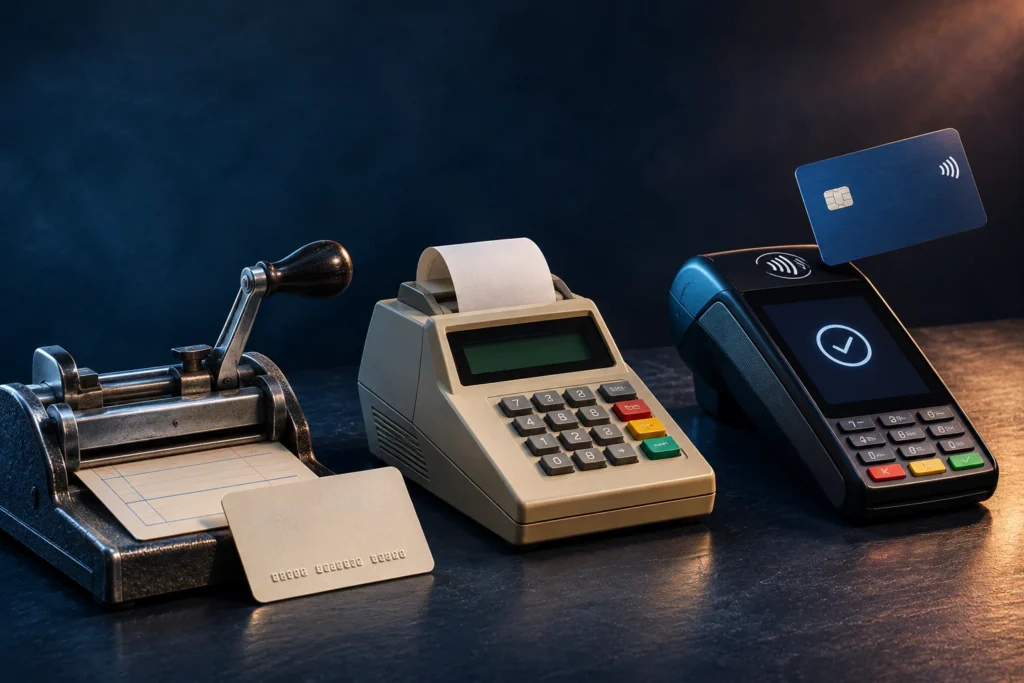

The history of credit card processing is the story of how businesses moved from handwritten sales slips and telephone approvals to electronic terminals, chip cards, and contactless payments. What now takes only moments at checkout once required paperwork, manual verification, and communication between merchants and financial institutions.
Today’s customers can pay with a card, smartphone, or compatible wearable device. However, the systems behind those transactions developed over many decades. The evolution was not one invention made by one company in one year.
I’ve worked in merchant services since co-founding Valued Merchant Services in 2006. Even within that period, I’ve watched merchants move from standalone terminals and paper-based procedures toward integrated POS systems, mobile acceptance, and increasingly sophisticated payment security.
How Credit Card Processing Changed Over Time
Understanding the earlier history helps explain why today’s payment systems involve card issuers, acquiring institutions, payment networks, processors, software providers, and merchants.
This guide focuses on how card payments were accepted and processed at the checkout counter, including the milestones that changed authorization, recordkeeping, security, and settlement.
Quick Answer: When Did Credit Card Processing Begin?
Merchant charge accounts existed long before modern credit cards. Diners Club introduced a widely recognized multipurpose charge card in 1950, and Bank of America launched BankAmericard in 1958. Early card transactions relied heavily on paper records and manual authorization. Electronic authorization developed through the 1960s and 1970s, followed by widespread magnetic-stripe terminals, networked POS systems, EMV chip payments, and contactless acceptance. These technologies were adopted gradually, not introduced everywhere at once.
In This Guide
- Credit card processing timeline
- Early store accounts and charge cards
- Manual card imprinters and paper slips
- Telephone authorization
- Electronic authorization and magnetic stripes
- EMV chip cards and payment security
- Contactless and mobile wallet payments
- Card transaction: then versus now
- What today’s merchants can learn
- Frequently asked questions
History of Credit Card Processing: Key Milestones
The following dates represent major developments in the United States and in the international standards that later influenced American card acceptance.
| Period | Milestone | Importance to merchants |
|---|---|---|
| Early 1900s | Retailer-specific charge accounts and cards | Customers could purchase on credit through participating merchants |
| 1928 | Charga-Plate payment recording system | Helped mechanize recordkeeping for store charge accounts |
| 1950 | Diners Club multipurpose charge card | One card could be used at multiple participating businesses |
| 1958 | BankAmericard introduced | Helped establish large-scale general-purpose revolving credit cards |
| 1966 | Interbank network formed; BankAmericard licensing expanded | Supported wider acceptance across different financial institutions |
| 1970s | Electronic point-of-sale and interbank communications developed | Reduced dependence on manual and paper-based authorization |
| 1976 | BankAmericard network adopted the Visa name | A major step in the identity of a global card-payment network |
| 1980s–1990s | Electronic terminals and magnetic-stripe acceptance became widespread | Helped make checkout authorization and transaction records more efficient |
| 1996 | EMV chip specifications published | Established interoperable standards for chip-based transactions |
| 2006 | PCI Security Standards Council founded | Strengthened coordinated payment-data security standards |
| 2014 | Apple Pay launched in the U.S. | Helped bring smartphone-based NFC payments into mainstream awareness |
| 2015 | Major U.S. EMV liability shift took effect for many in-person transactions | Accelerated adoption of chip-capable payment terminals, with exceptions and separate schedules |
Historical adoption occurred over time and varied by country, merchant, financial institution, and payment network. These dates should not be interpreted as the first possible use of every technology worldwide.
Historical references: Smithsonian National Museum of American History, Federal Reserve History, and EMVCo.
Before Modern Credit Cards: Store Accounts and Charge Plates
Modern bank-issued credit cards did not appear out of nowhere in the 1950s.
Retailers had offered customer credit arrangements for decades. A regular customer might purchase merchandise and pay later under an account maintained by that particular store.
Those arrangements were useful but limited. A customer generally could not expect the same store account to work at unrelated merchants.
Why the Charga-Plate Mattered
The Charga-Plate, introduced in 1928, was a small metal plate associated with a store charge account. Merchants could use it to make an imprint and streamline recordkeeping.
It did not function like a modern payment card linked through an electronic network.
Instead, it helped merchants document charges to an existing customer account.
The Smithsonian’s history of plastic payments documents this transition from store-specific systems toward broader card acceptance.
Diners Club and the Multipurpose Charge Card
Diners Club introduced a multipurpose charge card in 1950. Its distinguishing feature was acceptance at multiple participating establishments rather than only one retailer.
However, early Diners Club cards were charge cards. Cardholders generally had to pay their balances in full according to the account terms.
That distinction matters because a charge card is not identical to a revolving credit card that allows eligible balances to be carried forward with interest.
BankAmericard and the Growth of Bank-Issued Credit
Bank of America launched BankAmericard in California in 1958. It became an important predecessor of Visa and helped expand general-purpose revolving credit.
During the following decades, bank participation and acceptance networks grew.
As merchants began accepting cards issued by institutions outside their immediate area, transaction processing required more coordination among banks and networks.
For a documented account, see the Federal Reserve’s history of electronic point-of-sale payments.
Manual Credit Card Processing: Imprinters and Paper Sales Slips
For many years, accepting a credit card involved substantially more manual work than today’s checkout process.
One recognizable device was the manual card imprinter, sometimes nicknamed a knuckle-buster.
These devices were designed to transfer the raised information from an embossed card onto a paper sales slip.
How a Manual Card Transaction Worked
- Present the card. The customer handed the card to the merchant.
- Prepare the slip. The merchant placed the card and a sales form in the imprinter.
- Create an imprint. The device transferred embossed card details to the form.
- Complete the transaction record. The merchant entered the amount and other required information and obtained a signature when applicable.
- Follow authorization procedures. Depending on the merchant’s arrangement and the transaction, additional authorization might be required.
- Submit the transaction. The merchant delivered or transmitted the relevant sales records for processing and settlement under the procedures of the time.
These processes varied. Not every card purchase involved the same paperwork, authorization requirement, or bank relationship.
Still, compared with modern electronic processing, paper methods could require considerable handling and create opportunities for clerical mistakes.
What Merchants Had to Manage
A business had to protect its sales slips, retain appropriate records, submit transactions correctly, and reconcile payments against its business records.
These responsibilities provide historical context for modern payment processing.
Electronic systems eventually made many of these tasks easier, but they also introduced new technical and security responsibilities.
Telephone Authorization: Calling to Approve a Credit Card Sale
Before automated authorization became widely available, some credit card transactions required merchants to contact an authorization center by telephone.
The merchant supplied relevant account and transaction information and received an authorization response.
That process could take substantially longer than a modern electronic authorization request.
The Federal Reserve notes that earlier authorization systems frequently relied on telephone calls, while settlement and information exchange among institutions could still involve paper-based procedures.
Why Manual Authorization Was Inconvenient
For merchants, telephone authorization introduced extra steps and depended on access to the authorization service.
For customers, it could slow checkout.
However, it also served a practical purpose: helping merchants determine whether a card transaction should proceed under the relevant authorization rules.
Importantly, authorization did not mean the merchant had already received final settlement funds.
Electronic Credit Card Processing and Magnetic-Stripe Terminals
Electronic card authorization developed through many efforts involving banks, networks, technology suppliers, and merchants.
There is no accurate basis for saying that one company invented all electronic credit card processing in 1979.
By the early 1970s, the Federal Reserve was evaluating the role it might play in electronic point-of-sale communications, and some banks were already testing systems that transmitted payment requests electronically.
Ultimately, much of the point-of-sale network infrastructure developed through private-sector arrangements.
Why Electronic Authorization Changed Checkout
Instead of having a clerk telephone an authorization center, an electronic terminal could communicate transaction details through a network and receive an authorization response.
As systems matured, more businesses could complete this process during the customer’s checkout interaction.
This helped reduce dependence on manually handled authorization procedures.
However, the speed of authorization still depended on the available communications network, hardware, and processing arrangements.
The Importance of Magnetic-Stripe Cards
Magnetic stripes provided a way for compatible readers to obtain data stored on a card without manually copying embossed information.
For merchants, this made card-reading equipment and electronic authorization a practical combination.
Yet magnetic-stripe data also presented security limitations. Traditional stripe information is comparatively static, making counterfeit-card risks an important concern.
Those limitations helped drive later improvements in chip-based payment security.
Electronic Batches, Clearing, and Settlement
Modern payment acceptance involves more than receiving an approval message.
Transactions must also move through relevant clearing and settlement processes before the merchant receives funds according to the applicable agreement.
Electronic recordkeeping helped reduce manual handling, but authorization and funding remained distinct steps.
That distinction still matters for merchants evaluating deposit timing and reconciliation procedures today.
How Credit Card Networks Changed Merchant Acceptance
Card networks helped create systems in which participating merchants could accept eligible cards issued by many different financial institutions.
That required standards, communications infrastructure, and procedures connecting issuers, acquirers, and other participants.
Visa and the Former BankAmericard Network
BankAmericard began in 1958. Bank of America expanded licensing to other banks in 1966, and the network later adopted the Visa name in 1976.
The history illustrates how card acceptance grew beyond a product issued by one bank in one market.
Mastercard and the Interbank Network
Mastercard’s origins include the Interbank cooperative formed in 1966.
The broader development of these networks helped support acceptance across multiple issuers and merchants.
For a detailed historical account of these developments, consult Federal Reserve History.
The History of EMV Chip Cards and Payment Security
As card acceptance expanded, the limitations of traditional magnetic-stripe payments became more apparent.
Chip-based payment technology developed internationally, including early large-scale deployments in France.
The first EMV specifications were published in 1996, and EMVCo was formed in 1999 to maintain and develop interoperable specifications.
What Makes an EMV Chip Different?
EMV chip transactions use cryptographic mechanisms that help authenticate transactions and make certain types of counterfeit-card fraud more difficult.
In a properly conducted EMV transaction, dynamic transaction data helps reduce the usefulness of simply copying information from one transaction to another.
That differs from traditional magnetic-stripe data, which lacks equivalent transaction-specific cryptographic protection.
However, EMV is not a guarantee against every kind of payment fraud.
It does not independently prevent account takeover, all ecommerce fraud, compromised business accounts, or every possible network intrusion.
Why U.S. Merchants Heard So Much About October 2015
October 2015 marked an important U.S. liability shift for many in-person counterfeit-card transactions.
Under applicable card-network rules, liability could shift in certain circumstances when a transaction involved a chip-capable card and a party that had not adopted the required chip technology.
The rules had exceptions and different implementation schedules for particular environments.
Therefore, the shift should not be interpreted as meaning every merchant without EMV was automatically liable for all fraud.
The transition helped accelerate U.S. merchant adoption of chip-capable terminals.
Source: EMVCo: EMV Specifications and Payment Technology.
The Growth of Payment Security Standards
As electronic payment systems connected more merchants, networks, service providers, and software, the industry faced increasingly complex information-security responsibilities.
The Payment Card Industry Security Standards Council was founded in 2006 by major payment brands.
It manages standards and supporting programs intended to help protect payment account data.
PCI DSS, the Payment Card Industry Data Security Standard, addresses security requirements for applicable environments that store, process, or transmit payment account information.
Using an approved third-party payment service does not necessarily eliminate every merchant security responsibility.
The PCI Security Standards Council’s merchant resources explain current compliance considerations.
Contactless Cards, Mobile Wallets, and Tap-to-Pay
Contactless payments did not suddenly appear when smartphones became popular.
Contactless-card experiments and implementations existed before the widespread adoption of phone-based wallets.
The Federal Reserve Bank of Boston has documented U.S. contactless payment pilots beginning in 2003.
Apple Pay launched in the United States in 2014, helping bring near-field communication, or NFC, mobile wallet transactions to a broader consumer audience.
How Tap-to-Pay Differs From Swiping a Card
With a traditional magnetic-stripe transaction, a reader obtains stored information from the stripe.
With compatible contactless acceptance, the card or device communicates with the terminal over a short distance using supported payment technology.
Modern contactless EMV transactions use cryptographic protections rather than simply broadcasting a reusable copy of a magnetic stripe.
Mobile wallets may also use payment tokens and device-specific security measures, depending on the wallet and transaction.
What Changed for Merchants?
Customers gained more ways to pay without inserting or swiping a physical card.
At the same time, merchants needed compatible terminals, supported software, and appropriate transaction-processing arrangements.
Not every payment device supports every card, wallet, or acceptance method.
Therefore, businesses should verify actual capabilities rather than assuming a modern-looking terminal supports all payment options.
Source: Federal Reserve Bank of Boston: Payments Research.
Credit Card Processing: Then Versus Now
One of the simplest ways to understand the history of credit card processing is to compare the merchant’s experience across generations of technology.
| Transaction task | Earlier manual methods | Typical modern electronic methods |
|---|---|---|
| Read the card | Imprint embossed details or manually record information | Read a chip, stripe, or compatible contactless device |
| Request authorization | Telephone or other manual procedures when required | Electronic request through supported processing infrastructure |
| Record the transaction | Paper slips and manual reconciliation | Digital records and available POS or accounting integrations |
| Submit for settlement | Paper-based submission and institution-specific procedures | Electronic clearing and settlement arrangements |
| Protect payment information | Physical safeguarding of card slips and records | Appropriate device security, encryption, access controls, and data protection procedures |
These are general comparisons. Some modern businesses still encounter offline procedures, delayed authorizations, manual entry, and systems with limited integration.
The primary change is that many tasks once requiring paper handling and direct human intervention can now occur electronically.
What Happened to the Old Credit Card Imprinter?
Manual imprinters became much less central to payment acceptance as electronic terminals and card-reading technology became widespread.
The change was more than a matter of convenience.
Electronic systems could provide faster authorization, more consistent transaction records, and improved opportunities for integration and security.
However, some historical practices created security and operational risks that merchants should not reintroduce casually.
For example, retaining paper documents with exposed payment-card data can create obligations and vulnerabilities.
Today’s businesses should follow their processor’s approved procedures rather than assuming that a historical manual imprint is an acceptable fallback for an interrupted electronic system.
What This History Means for Small Business Owners Today
Understanding payment history can help owners evaluate modern equipment without assuming that every new product is automatically better.
1. Faster Authorization Is Not the Same as Faster Funding
A modern card payment may receive an authorization response quickly.
However, the timing of merchant deposits depends on clearing, settlement, processor arrangements, banking schedules, and any applicable funding service.
Ask providers to explain funding terms separately from checkout speed.
2. New Equipment Should Solve an Actual Business Need
A merchant with a reliable standalone terminal may not require a complicated POS system.
Conversely, a business with multiple locations, detailed inventory requirements, or specialized integrations may benefit from more advanced equipment.
Review our credit card terminal solutions to see the types of equipment businesses can evaluate.
3. Security Has Expanded Beyond the Physical Card
Earlier merchants concentrated heavily on paper slips and manual card handling.
Modern businesses must also consider software security, employee access, ecommerce applications, connected devices, and third-party service providers.
Our small business payment security guide explains practical safeguards.
4. Integration Can Matter More Than Hardware Appearance
A payment terminal that works well independently may still be unsuitable if it cannot meet the business’s operational requirements.
Before changing systems, verify compatibility with important POS, accounting, invoicing, or industry-specific software.
The history of processing shows that better coordination between payment and business systems has become one of the important improvements in merchant operations.
5. Choosing a Processor Still Requires Human Judgment
Even sophisticated technology cannot guarantee that one processing arrangement is best for every business.
Pricing, contractual obligations, customer support, payment methods, equipment compatibility, and funding needs all matter.
For more guidance, see our credit card processor selection guide.
How This Historical Guide Differs From the Broader Evolution of Payments
This article concentrates on the development of card acceptance and transaction processing: how merchants captured card details, obtained authorization, submitted transactions, and adopted newer payment technologies.
The wider history of payments also includes checks, ACH, bank transfers, ecommerce, digital platforms, and other systems.
For that broader perspective, read The Evolution of Payment Processing: Past, Present & Future.
The subjects are related, but understanding the mechanics of a historical credit card transaction is a different question from evaluating the overall evolution and future of payment technology.
Frequently Asked Questions About the History of Credit Card Processing
When did credit card processing begin?
Merchant charge accounts existed before modern credit cards. Multipurpose charge-card acceptance expanded with Diners Club in 1950, and bank-issued general-purpose credit cards gained momentum with BankAmericard in 1958. Electronic processing developed gradually during the following decades.
What was the first credit card?
The answer depends on the definition. Store charge cards and accounts existed earlier, while Diners Club introduced a widely recognized multipurpose charge card in 1950. BankAmericard, introduced in 1958, was an important early general-purpose revolving credit card.
How did merchants process credit cards before electronic terminals?
Merchants commonly used paper sales slips, manual imprinters, and established authorization procedures. Depending on the transaction, they might contact an authorization center by telephone and later submit records for processing.
What is a credit card imprinter?
A manual imprinter is a device that transfers embossed card information onto a paper sales slip. These devices were part of older card-acceptance procedures before electronic terminals became widespread.
When were electronic credit card terminals introduced?
Electronic authorization and point-of-sale systems developed through multiple efforts during the 1960s and 1970s, with adoption expanding over subsequent decades. No single year marks the beginning of all electronic card processing worldwide.
When did magnetic-stripe cards become popular?
Magnetic-stripe card acceptance expanded as electronic card readers and payment networks matured, particularly during the later twentieth century. Adoption varied by issuer, merchant, and country.
What is the history of EMV chip cards?
Chip-payment systems developed internationally before the U.S. transition. The first EMV specifications were published in 1996, and EMVCo was established in 1999 to manage and advance the specifications.
Why was October 2015 important for U.S. credit card processing?
October 2015 marked a major liability shift for many in-person counterfeit-card transactions under U.S. card-network rules. The change encouraged businesses to adopt compatible chip-card technology, although exceptions and separate schedules applied.
When did contactless credit card payments begin?
Contactless payment technologies appeared before smartphone wallets. U.S. contactless payment pilots began in the early 2000s, and mobile wallet adoption expanded significantly after products such as Apple Pay launched in 2014.
Does EMV eliminate credit card fraud?
No. EMV technology helps protect against certain counterfeit-card risks, but other forms of payment fraud, account compromise, and cybersecurity threats remain possible.
What is the difference between authorization and settlement?
Authorization is the process of requesting approval for a transaction. Clearing and settlement involve subsequent exchange of transaction information and funds under the applicable payment arrangements. An approved card payment does not automatically mean the merchant has received its deposit.
Why should a merchant understand payment processing history?
It explains why today’s payment systems contain multiple participants and security controls, why funding differs from authorization, and why equipment compatibility and processing agreements matter when selecting payment technology.
Final Thoughts: From Manual Imprints to Modern Payments
The history of credit card processing illustrates decades of changes in technology, banking infrastructure, merchant operations, and payment security.
Early transactions relied heavily on paper records and manual communication. Electronic authorization reduced many of those steps. Magnetic stripes enabled card-reading terminals, while EMV and contactless technologies improved important aspects of in-person payment acceptance.
Yet the underlying business question remains familiar: how can merchants accept customer payments reliably, securely, and at a reasonable total cost?
Since co-founding Valued Merchant Services in 2006, I’ve watched the range of available equipment and software expand considerably.
More choices can be valuable, but only when those choices address the merchant’s actual needs.
Understanding where payment processing came from helps business owners make better decisions about the technology they use today.
Is Your Payment Technology Still the Right Fit?
Valued Merchant Services helps businesses evaluate credit card processing, payment terminals, POS systems, ecommerce solutions, and related services. We’ll explain the available options and help you decide whether your current equipment and processing arrangement meet your needs.
Call 800-531-8575 or email support@valuedmerchants.com. Equipment, pricing, integrations, security features, and funding options depend on the applicable provider and merchant arrangement. We will also tell you when your existing setup is already a suitable choice.
Updated November 2026. This historical article replaces the original 2017 version. Dates and technical developments are based on identified museum, Federal Reserve, EMVCo, and payment security industry sources. Historical practices varied across countries, merchants, and financial institutions. This article provides general educational information rather than individualized compliance, security, or legal advice.
